


s
s



24-hour
Produodopa® is the first subcutaneous 24-hour infusion that provides continuous stable levodopa plasma levels.1


More Motor Control*
Improved motor symptom control continuously morning, day, and night†‡ without surgery.1,2

Continuous and Personalized
Produodopa® provides a wide range of customisable dosing, delivered via a single infusion site and cannula that can remain in place for up to 3 days, to accommodate individual patient needs.1§
Produodopa® can be taken alone or, if necessary, with other concurrent medicinal products for PD, based on the judgment of the HCP.1
The most frequent adverse reactions (≥10%) were infusion site events (infusion site erythema, infusion site cellulitis, infusion site nodule, infusion site pain, infusion site oedema, infusion site reaction, and infusion site infection), hallucination, fall, and anxiety.1
*More refers to "On" time compared to oral IR LD/CD. Patients in the Produodopa® study experienced significant improvements compared with oral IR LD/CD at Week 12, including "On" time without troublesome dyskinesia and "Off" time.1,2
†Patients made an entry in a PD Diary upon waking and every 30 minutes during their normal waking time and upon awakening from time asleep.2
‡Produodopa® is a levodopa-based therapy delivered subcutaneously as a 24-hour infusion.1
§Rotate the infusion site and use a new infusion set at least every three days. Produodopa® allows for dosing up to 4260 mg levodopa/day with 3 programmable flow rates (base, high, and low) and an extra-dose capability. Infusion rates may be adjusted in increments as small as 0.01 mL/hour (~1.7 mg of levodopa/hour).1
HCP=healthcare professional; IR=immediate-release; LD/CD=levodopa/carbidopa; PD=Parkinson's disease.
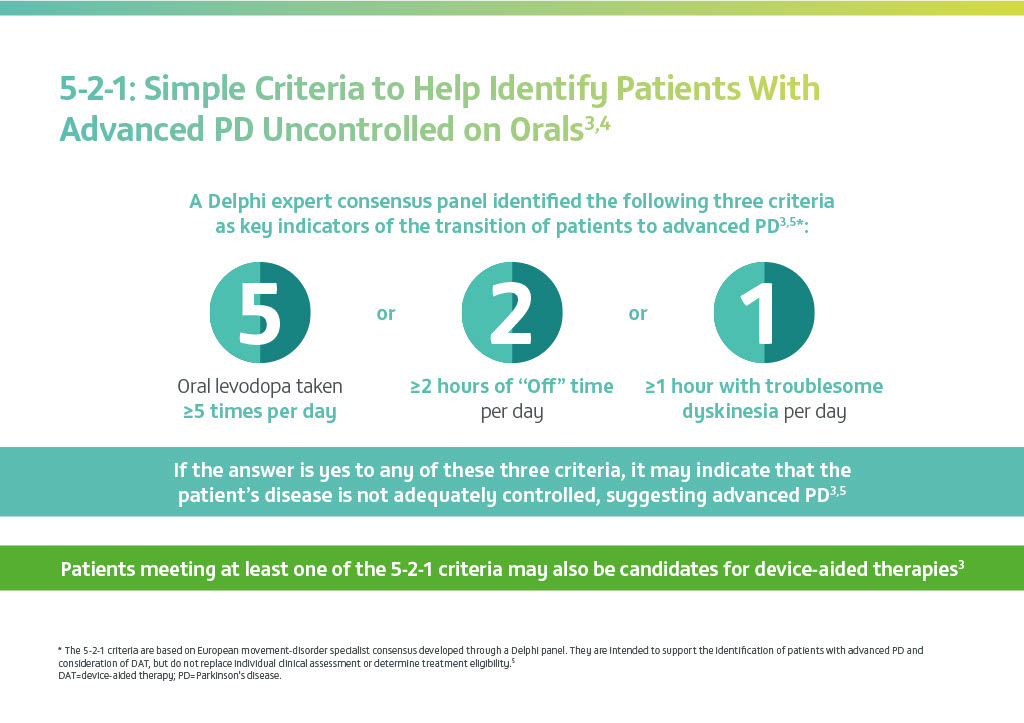
Helping to identify patients with advanced parkinson’s disease: The 5-2-1 Criteria

WHY PRODUODOPA?

CLINICAL PROFILE

SAFETY

INITIATION & CUSTOMISATION
- Produodopa® (foslevodopa/foscarbidopa solution for infusion) Summary of Product Characteristics, available on www.medicines.ie.
- Soileau MJ, et al. Lancet Neurol. 2022; 21:1099–1109 (incl. suppl.).
- Aldred J, et al. Neurodegener Dis Manag. 2020;10(5):309-323.
- Antonini A, et al. Curr Med Res Opin. 2018;34(12):2063-2073.
- Antonini A, et al. BMC Neurol. 2024;24:266.
IE-PRODD-260005 Date of preparation: October 2026.
