



RINVOQ is indicated for the treatment of moderate to severe atopic dermatitis (AD) in adults and adolescents 12 years and older who are candidates for systemic therapy.1
LEVEL UP PERIOD 1 & 2
Consistent safety profile in AD through Week 322,3
MONOTHERAPY | LEVEL UP PERIOD 1 & 2
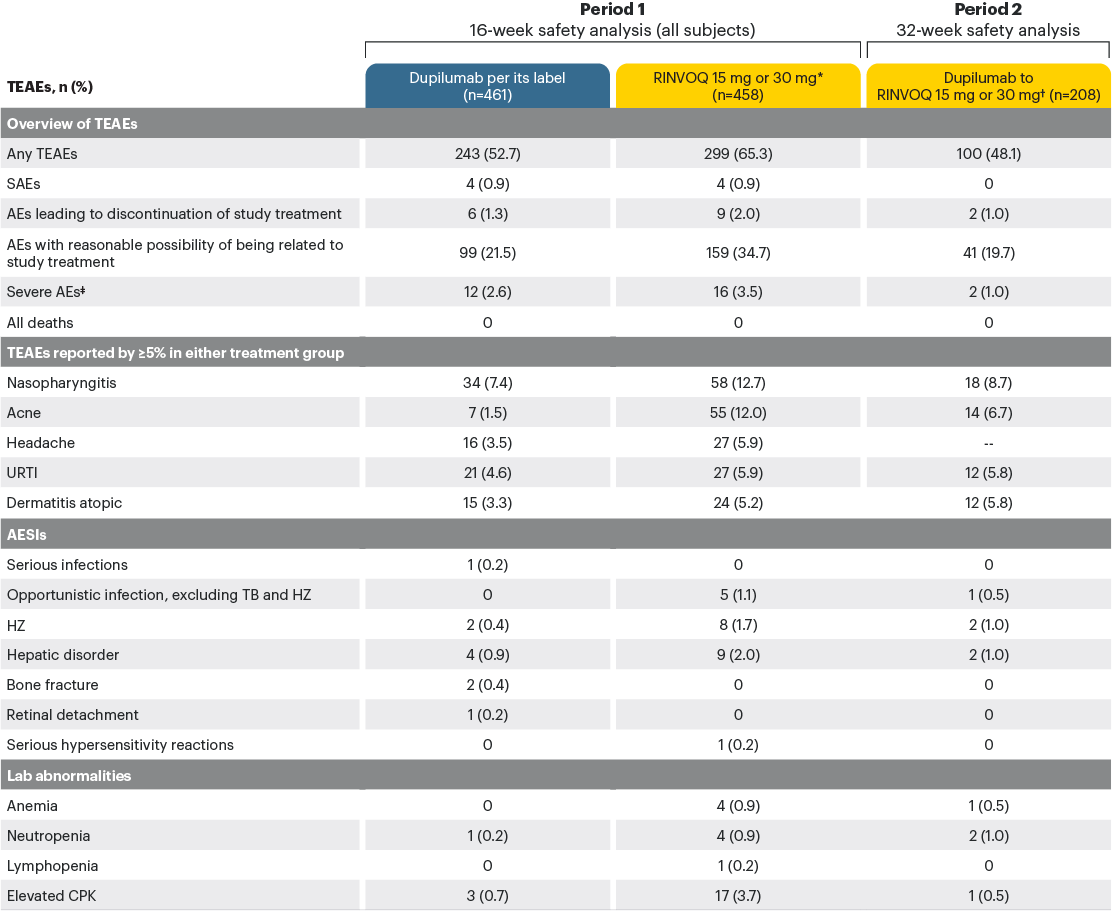
No incidence of active TB, malignancy, adjudicated GI perforations, adjudicated MACE, adjudicated VTE, or renal dysfunction were observed across any of the treatment groups.
*Patients were initiated on RINVOQ 15 mg QD and dose-escalated to 30 mg QD based on clinical response. †Patients randomized to dupilumab in Period 1 and treated with RINVOQ in Period 2. ‡Common Terminology Criteria for Adverse Events toxicity grade ≥ 3.
Summary of Product Characteristics
In the placebo-controlled atopic dermatitis clinical trials, the most commonly reported adverse reactions (≥2% of patients) with upadacitinib 15 mg or 30 mg were upper respiratory tract infection (25.4%), acne (15.1%), herpes simplex (8.4%), headache (6.3%), blood CPK increased (5.5%), cough (3.2%), folliculitis (3.2%), abdominal pain (2.9%), nausea (2.7%), neutropenia (2.3%), pyrexia (2.1%), and influenza (2.1%).
§§ELEVATE: AbbVie defines "ELEVATE" as the raising of the standards of care in AD patients, measured by WP-NRS and EASI score, treated with Dupilumab vs RINVOQ at week 16 of the head to head trials.2,3


FIND OUT MORE ABOUT RINVOQ
REFERENCES
- RINVOQ® (upadacitinib) Summary of Product Characteristics, available at www.medicines.ie.
- Silverberg JI, Bunick CG, Hong HC, et al. Efficacy and safety of upadacitinib versus dupilumab in adults and adolescents with moderate-to-severe atopic dermatitis: week 16 results of an open-label randomized efficacy assessor-blinded head-to-head phase IIIb/IV study (Level Up). Br J Dermatol. 2024;192(1):36-45.
- Bunick CG, Magnolo N, Moore A, et al. Switching from dupilumab to upadacitinib in Adults and Adolescents with Moderate-to-Severe Atopic Dermatitis and Inadequate Response to Dupilumab: Efficacy and Safety Results from the Phase 3b/4 LEVEL UP Study. Presented at Fall Clinical Dermatology Conference, Las Vegas, NV, October 24-27, 2024.
IE-RNQD-260012 Date of Preparation: May 2026
