



RINVOQ is indicated for the treatment of moderate to severe atopic dermatitis (AD) in adults and adolescents 12 years and older who are candidates for systemic therapy.1

HEADS UP: Study design3,4
OBJECTIVE: To evaluate the efficacy and safety of RINVOQ vs dupilumab in adult subjects with moderate to severe AD who are candidates for systemic therapy
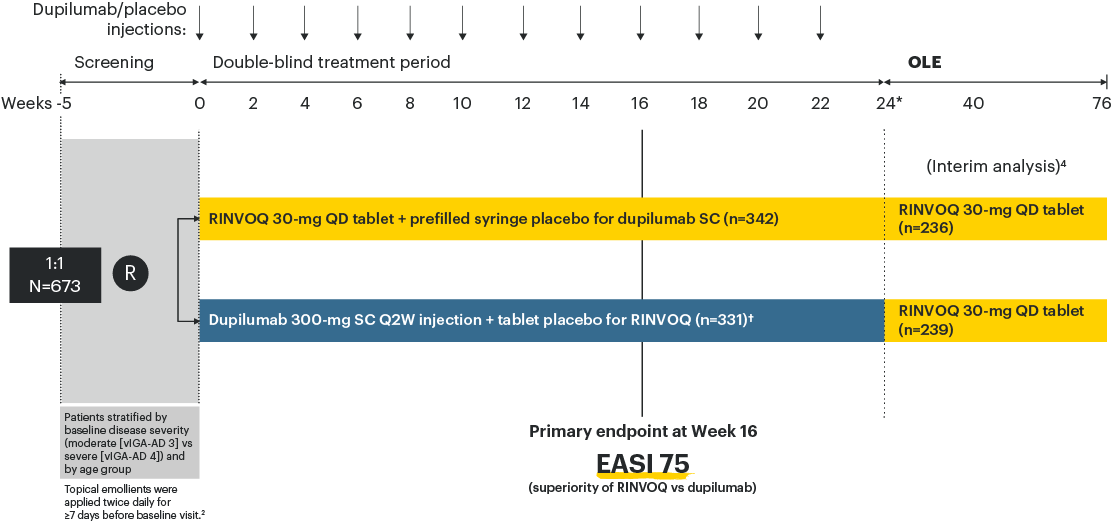
Efficacy analysis was conducted in the ITT population during the double-blind treatment period, and missing data for the primary and ranked secondary endpoints were handled using NRI-C.3 *Patients not entering the OLE had a 12-week follow-up visit. Patients received Dupilumab 300mg SC Q2W starting from week 2 visit until week 22.3 †Patients randomized to the dupilumab 300-mg SC Q2W group received the starting dose of 600 mg at the baseline visit.3 The prespecified interim analysis for the OLE study was conducted at week 16.4
HEADS UP: Primary and ranked secondary endpoints3
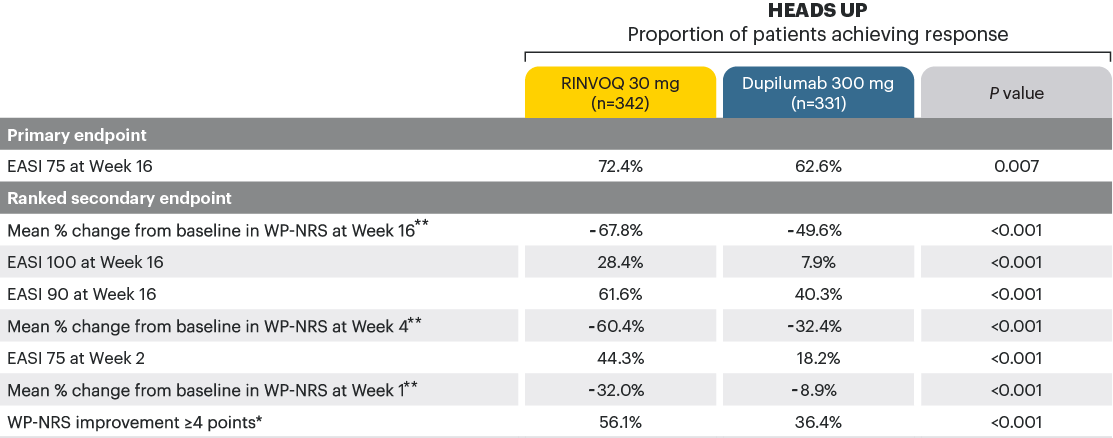
*Analyzed for patients with WP-NRS ≥4 points at baseline.
**Least-squares mean (SD) [95% Cl].
With RINVOQ, BOTH little to no itch AND almost clear skin could be within reach for your patients with AD
Patients on RINVOQ 30 mg simultaneously achieved little to no itch and almost clear skin at Week 163,5-7
MONOTHERAPY | POST HOC ANALYSIS OF HEADS UP
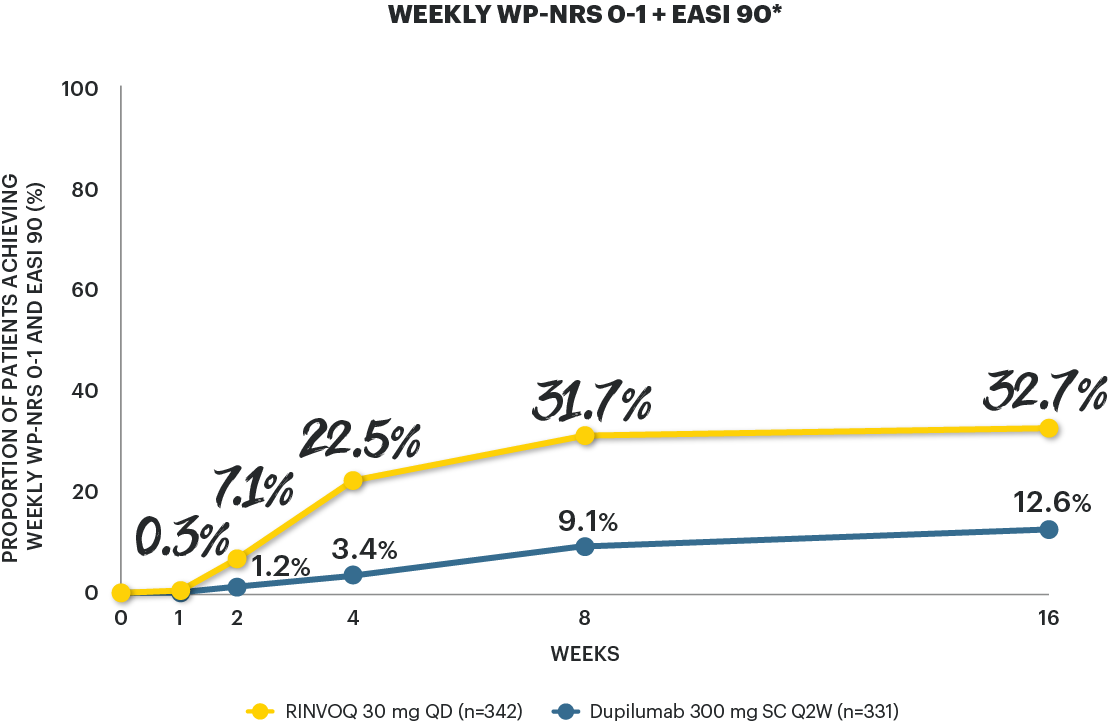
Patients presented: Post hoc analysis including adult patients (18-75 years of age) randomized 1:1 to RINVOQ 30 mg QD or dupilumab 300 mg SC Q2W with a WP-NRS >1 at baseline. Click to see the Study Design for further study details.3 For AD, doses higher than 15 mg once daily are not recommended in patients 65 years of age and older (see sections 4.4 and 4.8 of the SmPC).
DATA LIMITATIONS: Post hoc analysis of the HEADS UP study. Data were nonranked endpoints not controlled for multiplicity. Thus, results cannot be considered statistically significant.3,7
*The achievement of WP-NRS 0-1 + EASI 90 is an example of minimal disease activity, defined as the simultaneous achievement of optimal treatment targets.8
Data through Week 40 after switching to RINVOQ 30 mg from dupilumab4-6
MONOTHERAPY | POST HOC ANALYSIS OF HEADS UP OPEN-LABEL EXTENSION
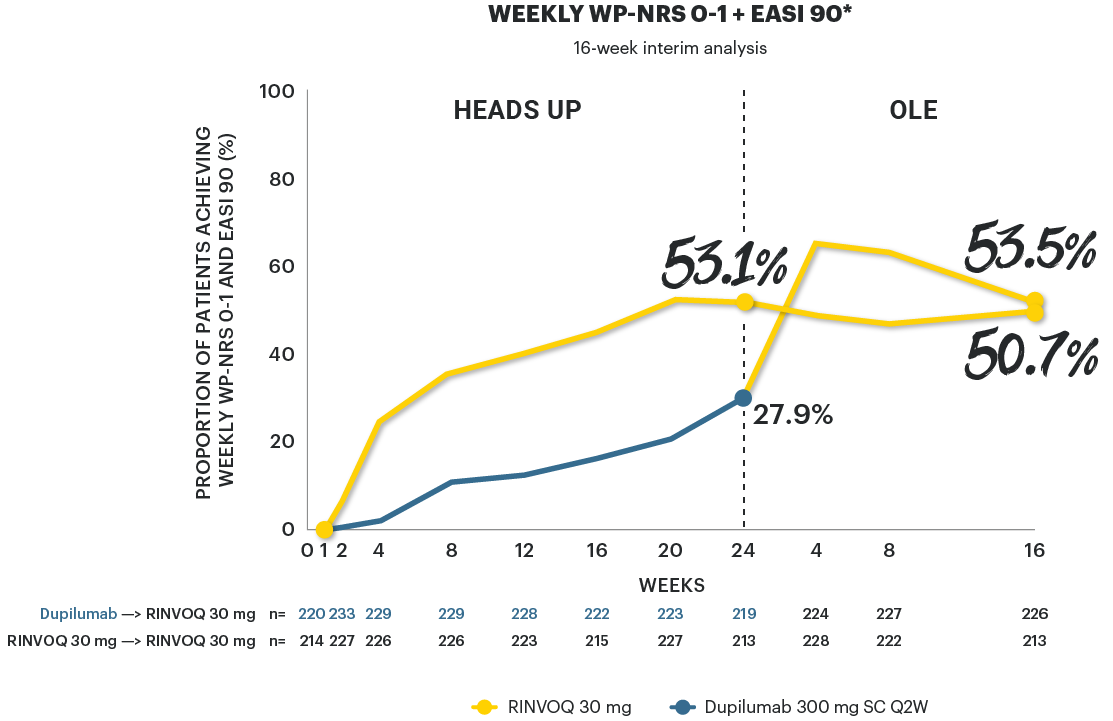
Adapted from Blauvelt et al, 2023.
Patients presented: Adult patients 18-75 years of age who completed HEADS UP without meeting study drug discontinuation criteria or developing any permanent discontinuation criteria were eligible for OLE enrollment. For AD, doses higher than 15 mg once daily are not recommended in patients 65 years of age and older (see sections 4.4 and 4.8 of the SmPC). Patients on RINVOQ 30 mg QD continued on the same RINVOQ dose, while patients on dupilumab were switched to RINVOQ 30 mg QD at Week 24. The primary endpoint of the OLE was safety. WP-NRS 0-1 + EASI 90 was a post hoc assessment in patients with baseline WP-NRS of ≥4.
Click to see the Study Design for further study details.4
DATA LIMITATIONS: Only patients who had observed values were included. If a subject missed any value, this subject was not included in the analysis. From Week 24, all patients received oral RINVOQ 30 mg QD for 16 weeks. A 2-week interval between the last dupilumab dose and first RINVOQ dose may not allow for complete elimination of dupilumab, so initial synergistic activity cannot be ruled out.4
*The achievement of WP-NRS 0-1 + EASI 90 is an example of minimal disease activity, defined as the simultaneous achievement of optimal treatment targets.8
§§ELEVATE: AbbVie defines "ELEVATE" as the raising of the standards of care in AD patients, measured by WP-NRS and EASI score, treated with Dupilumab vs RINVOQ at week 16 of the head to head trials.2,3


FIND OUT MORE ABOUT RINVOQ
REFERENCES
- RINVOQ® (upadacitinib) Summary of Product Characteristics, available at www.medicines.ie.
- Silverberg JI, Bunick CG, Hong HC, et al. Efficacy and safety of upadacitinib versus dupilumab in adults and adolescents with moderate-to-severe atopic dermatitis: week 16 results of an open-label randomized efficacy assessor-blinded head-to-head phase IIIb/IV study (Level Up). Br J Dermatol. 2024;192(1):36-45.
- Blauvelt A, Teixeira HD, Simpson EL, et al. Efficacy and safety of upadacitinib vs dupilumab in adults with moderate-to-severe atopic dermatitis: a randomized clinical trial. JAMA Dermatol. 2021;157(9):1047-1055
- Blauvelt A, Ladizinski B, Prajapati VH, et al. Efficacy and safety of switching from dupilumab to upadacitinib versus continuous upadacitinib in moderate-to-severe atopic dermatitis: results from an open-label extension of the phase 3, randomized, controlled trial (Heads Up). J Am Acad Dermatol. 2023;89(3):478-485.
- Leshem YA, Hajar T, Hanifin JM, Simpson EL. What the Eczema Area and Severity Index score tells us about the severity of atopic dermatitis: an interpretability study. Br J Dermatol. 2015;172(5):1353-1357.
- Phan NQ, Blome C, Fritz F, et al. Assessment of pruritus intensity: prospective study on validity and reliability of the visual analogue scale, numerical rating scale and verbal rating scale in 471 patients with chronic pruritus. Acta Derm Venereol. 2012;92(5):502-507.
- Simpson EL, Silverberg JI, Prajapati VH, et al. Rapid itch improvement and skin clearance with upadacitinib versus placebo (Measure Up 1 and Measure Up 2) and versus dupilumab (Heads Up): Results from three Phase 3 clinical trials in patients with moderate-to-severe atopic dermatitis. Dermatol Ther (Heidelb). 2025;15(8):2061-2076.
- Silverberg JI, Gooderham M, Katoh N, et al. Combining treat-to-target principles and shared decision-making: international expert consensus-based recommendations with a novel concept for minimal disease activity criteria in atopic dermatitis. J Eur Acad Dermatol Venereol. 2024;38(11):2139-2148.
IE-RNQD-260010 Date of Preparation: May 2026
