



RINVOQ is indicated for the treatment of moderate to severe atopic dermatitis (AD) in adults and adolescents 12 years and older who are candidates for systemic therapy.1

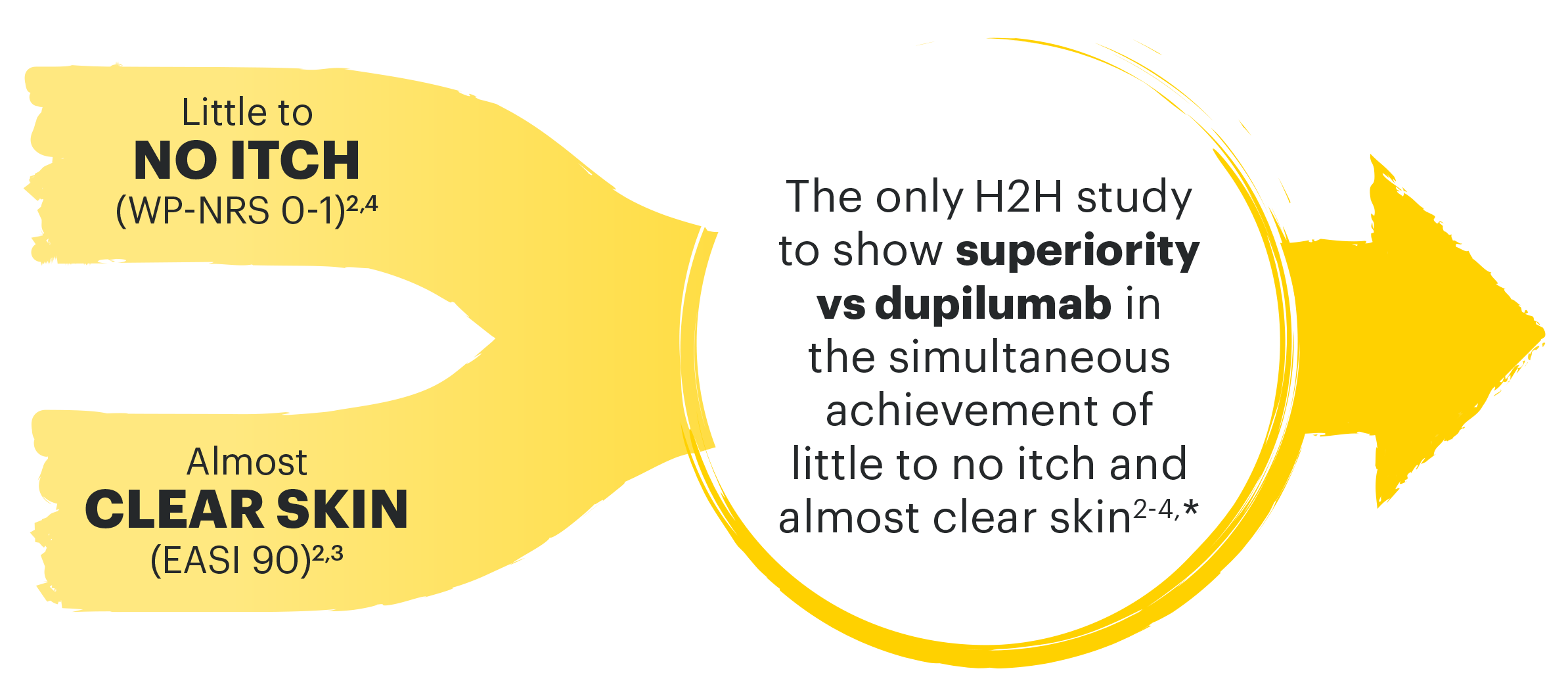
Study objective: LEVEL UP is a Phase 3b/4 global, randomized, open-label H2H study evaluating the efficacy and safety of RINVOQ compared with dupilumab in adults and adolescents (≥12-<64 years of age) with moderate to severe AD. Patients on RINVOQ were initiated at 15 mg QD and dose-adjusted based on clinical response. Dupilumab was administered per its label. The primary endpoint was met at Week 16 (P<0.001 vs dupilumab, ITT [NRI-MI], multiplicity-controlled analysis).2
*The primary endpoint of LEVEL UP, the simultaneous achievement of WP-NRS 0-1 and EASI 90, is an example of minimal disease activity, defined as the achievement of optimal treatment targets.2,5
LEVEL UP: Study design2
OBJECTIVE: A Phase 3b/4 global head-to-head study evaluating the efficacy and safety of RINVOQ vs dupilumab in adolescents and adults with moderate to severe AD who had inadequate response to systemic therapy or when those therapies were inadvisable

*Up to 35 days.2 †For subjects who do not enter study Period 2.2
The recommended dose of RINVOQ is 15 mg QD for adolescents (12-17 years of age) weighing at least 30 kg. If an adolescent patient does not respond adequately to RINVOQ 15 mg once daily, the dose can be increased to 30 mg once daily. The posology in adolescent patients 30 kg to <40 kg was determined using population pharmacokinetic modeling and simulation. No clinical exposure data are available in adolescents <40 kg. The safety and efficacy of RINVOQ in children with AD below the age of 12 years have not been established. No data are available.1
RINVOQ delivered superior results vs dupilumab in the simultaneous achievement of little to no itch and almost clear skin at Week 162-4
MONOTHERAPY | LEVEL UP PERIOD 1

Study design: Phase 3b/4, randomized, open-label efficacy assessor-blinded head-to-head trial of 920 adult and adolescent patients (≥12 and <64 years of age weighing ≥40 kg) with moderate to severe AD. Patients were randomized to RINVOQ 15 mg QD (n=458) or dupilumab per its label (n=462). Patients were initiated on RINVOQ 15 mg and dose-adjusted based on clinical response. Patients randomized to RINVOQ 15 mg QD had their dose increased to 30 mg QD if any of the following parameters were met: starting at Week 4, patient had a <EASI 50 response; starting at Week 4, patient had a <4-point improvement in WP-NRS; starting at Week 8, patient had a <EASI 75 response. Click to see the Study Design for complete study details.2
*The achievement of WP-NRS 0-1 + EASI 90 is an example of minimal disease activity, defined as the simultaneous achievement of optimal treatment targets.5
Dose-escalation status of all patients receiving RINVOQ in Period 12

*91 patients on RINVOQ simultaneously achieved the primary endpoint, little to no itch (WP-NRS 0-1) and almost clear skin (EASI 90), at Week 16 (Period 1).2 †Dose escalation at a visit occurred after clinical assessments at the corresponding visit. Patients were dose-escalated if starting at Week 4, patient has a <EASI 50 response or a <4-point improvement from baseline in WP-NRS (weekly average), and starting at Week 8, patient has a <EASI 75 response.2
Data are descriptive. As a dose-escalation study, LEVEL UP was not designed to show superiority of RINVOQ 15 mg vs dupilumab.2
FOR PATIENTS WHO EXPERIENCED AN
INADEQUATE RESPONSE TO DUPILUMAB (DUPI-IR)*,
SEE WHAT A SWITCH TO RINVOQ COULD DO
At the start of the switch period and prior to switching to RINVOQ, patients on dupilumab (DUPI-IR) had6,7:
Itch
4.1
mean WP-NRS (weekly average)
n=200
Skin clearance
≈EASI 50
mean EASI score of ≈14
n=208
Study design: Efficacy assessor–blinded open-label extension period (Period 2) of the LEVEL UP study. 208 adult and adolescent patients with inadequate responses to dupilumab at the end of Period 1* entered Period 2. DUPI-IR patients were initiated on RINVOQ 15 mg and had their dose increased to RINVOQ 30 mg if any of the following parameters were met: starting at Week 20, they had a <EASI 75 response; starting at Week 20, they had a <4-point improvement from baseline in WP-NRS. Click to see the Study Design for complete study details.2
*DUPI-IR; defined as failure to achieve an EASI 75 response at Week 16.2,6
DATA LIMITATIONS: Efficacy results were prespecified, nonranked endpoints not controlled for multiplicity. Only patients who had observed values were included. Patients who initiated topical rescue treatments during Period 2 were imputed as nonresponders for the remainder of the period. Data are descriptive in nature. No statistical inferences can be made regarding differences between treatment groups.6
Switching to RINVOQ from dupilumab could make a difference for your DUPI-IR* patients in achieving little to no itch and almost clear skin simultaneously between Weeks 16 and 323,4,6
MONOTHERAPY | LEVEL UP PERIOD 2 OPEN-LABEL EXTENSION
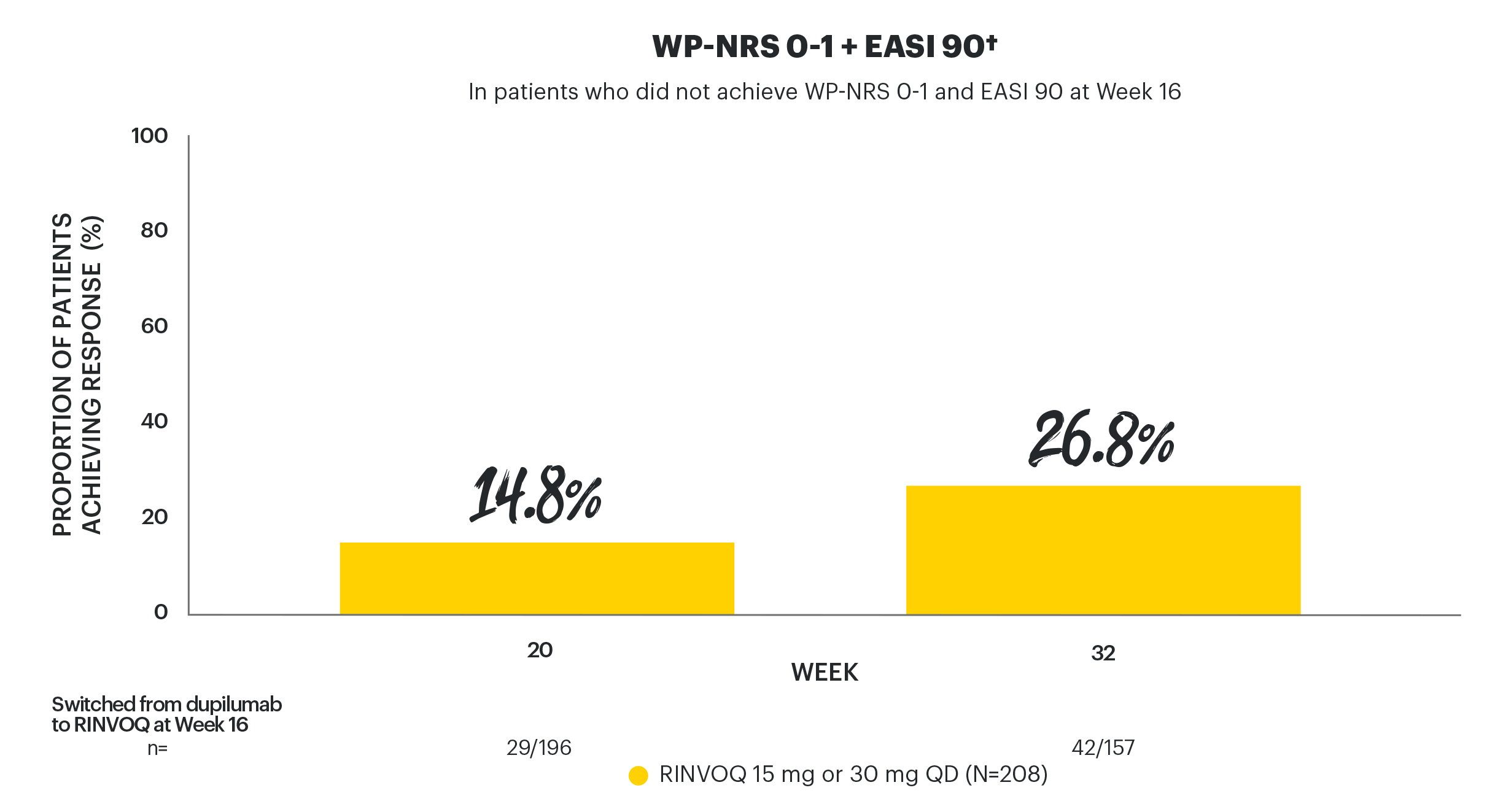
Patients presented: Adult and adolescent patients with inadequate responses to dupilumab at the end of Period 1* were eligible for the 16-week OLE (Period 2) of LEVEL UP. DUPI-IR* patients were initiated on RINVOQ 15 mg and had their dose increased to RINVOQ 30 mg if any of the following parameters were met: starting at Week 20, they had a <EASI 75 response; starting at Week 20, they had a <4-point improvement from baseline in WP-NRS. Click to see the Study Design for complete study details.2
DATA LIMITATIONS: Data were prespecified, nonranked endpoints not controlled for multiplicity. Only patients who had observed values were included. Patients who initiated topical rescue treatments during Period 2 were imputed as nonresponders for the remainder of the period. No statistical inferences can be made regarding differences between treatment groups.2,6
*DUPI-IR was defined as failure to achieve an EASI 75 response at Week 16.6 †The achievement of WP-NRS 0-1 + EASI 90 is an example of minimal disease activity, defined as the simultaneous achievement of optimal treatment targets.5
§§ELEVATE: AbbVie defines "ELEVATE" as the raising of the standards of care in AD patients, measured by WP-NRS and EASI score, treated with Dupilumab vs RINVOQ at week 16 of the head to head trials.2,6


FIND OUT MORE ABOUT RINVOQ
REFERENCES
- RINVOQ® (upadacitinib) Summary of Product Characteristics, available at www.medicines.ie.
- Silverberg JI, Bunick CG, Hong HC, et al. Efficacy and safety of upadacitinib versus dupilumab in adults and adolescents with moderate-to-severe atopic dermatitis: week 16 results of an open-label randomized efficacy assessor-blinded head-to-head phase IIIb/IV study (Level Up). Br J Dermatol. 2024;192(1):36-45.
- Leshem YA, Hajar T, Hanifin JM, Simpson EL. What the Eczema Area and Severity Index score tells us about the severity of atopic dermatitis: an interpretability study. Br J Dermatol. 2015;172(5):1353-1357.
- Phan NQ, Blome C, Fritz F, et al. Assessment of pruritus intensity: prospective study on validity and reliability of the visual analogue scale, numerical rating scale and verbal rating scale in 471 patients with chronic pruritus. Acta Derm Venereol. 2012;92(5):502-507.
- Silverberg JI, Gooderham M, Katoh N, et al. Combining treat-to-target principles and shared decision-making: international expert consensus-based recommendations with a novel concept for minimal disease activity criteria in atopic dermatitis. J Eur Acad Dermatol Venereol. 2024;38(11):2139-2148.
- Blauvelt A, Teixeira HD, Simpson EL, et al. Efficacy and safety of upadacitinib vs dupilumab in adults with moderate-to-severe atopic dermatitis: a randomized clinical trial. JAMA Dermatol. 2021;157(9):1047-1055.
- AbbVie Data on File: ABVRRTI79834.
- Bunick C et al, Switching from Dupilumab to Upadacitinib in Adults and Adolescents with Moderate-to-Severe Atopic Dermatitis and Inadequate Response to Dupilumab: Efficacy and Safety Results from the Phase 3b/4 LEVEL UP Study. Clinical Dermatology Conference, Las Vegas, NV, October 24-27, 2024.
IE-RNQD-260010 Date of Preparation: May 2026
