



RINVOQ is indicated for the treatment of moderate to severe atopic dermatitis (AD) in adults and adolescents 12 years and older who are candidates for systemic therapy.1
Achievement of Head and Neck EASI 90/100 with RINVOQ 30mg and dupilumab through Week 162
POST HOC ANALYSIS OF HEADS UP
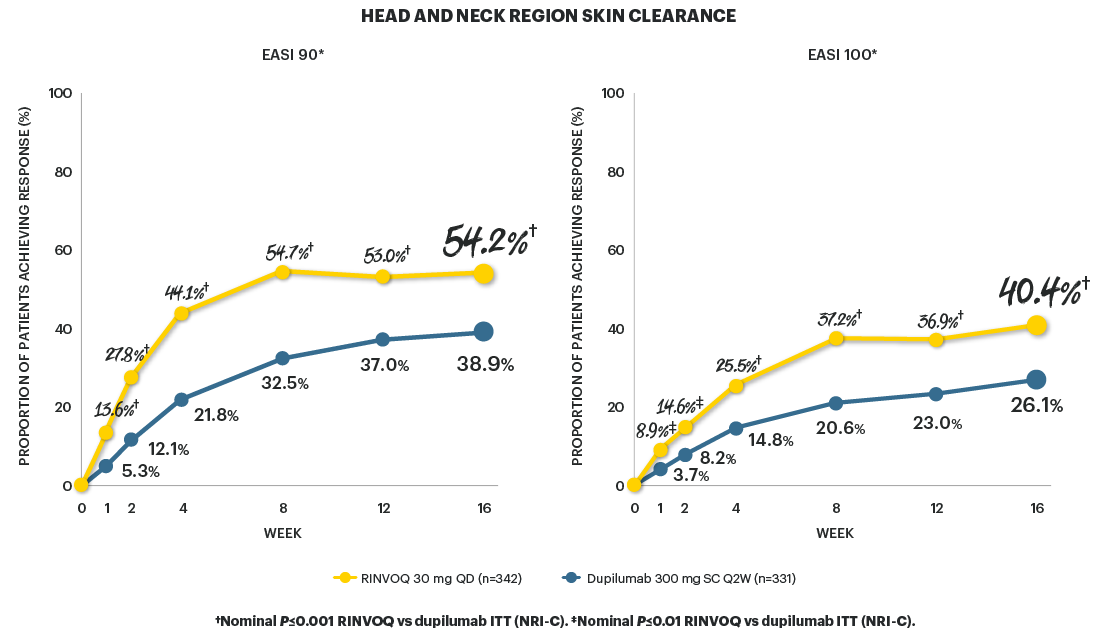
Patients presented: Adult patients (18-75 years of age) randomized 1:1 to RINVOQ 30 mg QD or dupilumab 300 mg SC Q2W. These patients represent those with head and neck involvement. For AD, doses higher than 15 mg once daily are not recommended in patients 65 years of age and older (see sections 4.4 and 4.8 of the SmPC).
DATA LIMITATIONS: Data were nonranked endpoints not controlled for multiplicity. Thus, results cannot be considered statistically significant.2
*EASI 90/100 head and neck defined as at least a 90/100 percent reduction in EASI subscore in the head and neck region ITT population.2
RINVOQ improved head and neck skin clearance in moderate and severe symptom severity at week 163,4
MONOTHERAPY | INTEGRATED POST HOC ANALYSIS OF MEASURE UP 1 & 2
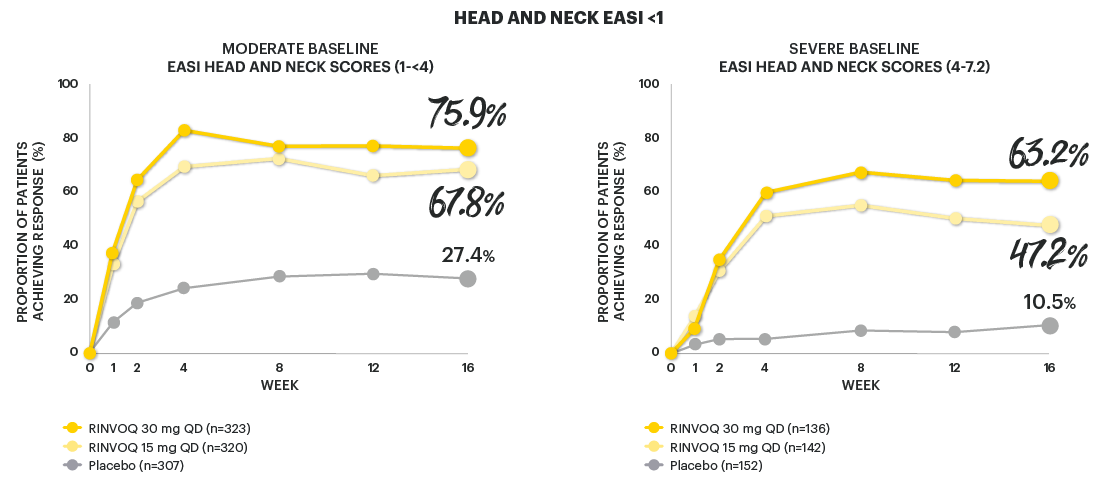
Patients presented: Adult and adolescent (≥12 years of age) patients were randomized 1:1:1 in MEASURE UP 1 & 2. These patients represent those with head and neck involvement. Results are based on NRI-NC. Data were stratified by baseline head and neck EASI score.
DATA LIMITATIONS: Analyses are post hoc, do not assess a prespecified endpoint, and were not adjusted for multiplicity. Therefore, treatment differences cannot be regarded as statistically significant.4
QoL in AD patients with head and neck involvement at Week 163,4
MONOTHERAPY | INTEGRATED POST HOC ANALYSIS OF MEASURE UP 1 & 2
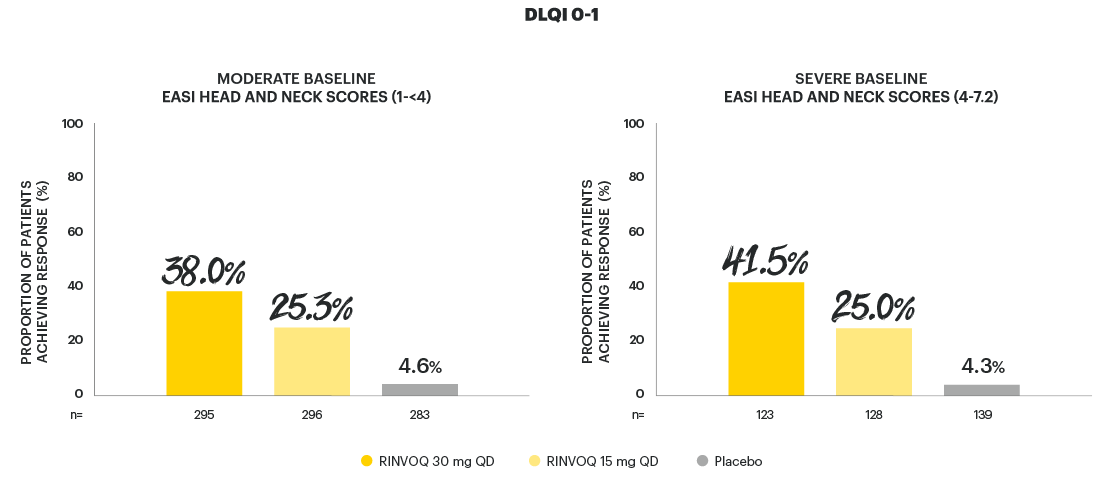
Patients presented: Adult and adolescent (≥12 years of age) patients were randomized 1:1:1 in MEASURE UP 1 & 2. Data were stratified by baseline head and neck EASI score.
DATA LIMITATIONS: Analyses are post hoc, do not assess a prespecified endpoint, and were not adjusted for multiplicity. Therefore, treatment differences cannot be regarded as statistically significant.4
§§ELEVATE: AbbVie defines "ELEVATE" as the raising of the standards of care in AD patients, measured by WP-NRS and EASI score, treated with Dupilumab vs RINVOQ at week 16 of the head to head trials.5,6


FIND OUT MORE ABOUT RINVOQ
REFERENCES
- RINVOQ® (upadacitinib) Summary of Product Characteristics, available at www.medicines.ie.
- Thyssen JP, Rosmarin D, Costanzo A, et al. Efficacy and safety of upadacitinib versus dupilumab treatment for moderate-to-severe atopic dermatitis in four body regions: analysis from the Heads Up study. Dermatology. 2025;241(1):10-18.
- Eyerich K, Mendes-Bastos P, Holzer G, et al. Efficacy of upadacitinib in treating atopic dermatitis in the head and neck regions. Presented at European Academy of Dermatology and Venerology (EADV); Sept 25-28, 2025, Amsterdam, The Netherlands.
- Guttman-Yassky E, Teixeira HD, Simpson EL, et al. Once-daily upadacitinib versus placebo in adolescents and adults with moderate-to-severe atopic dermatitis (Measure Up 1 and Measure Up 2): results from two replicate double-blind, randomised controlled phase 3 trials. Lancet. 2021;397(10290):2151-2168.
- Silverberg JI, Bunick CG, Hong HC, et al. Efficacy and safety of upadacitinib versus dupilumab in adults and adolescents with moder‐ ate-to-severe atopic dermatitis: week 16 results of an open-label randomized efficacy assessor-blinded head-to-head phase IIIb/IV study (Level Up). Br J Dermatol. 2024;192(1):36-45.
- Blauvelt A, Ladizinski B, Prajapati VH, et al. Efficacy and safety of switching from dupilumab to upadacitinib versus continuous upadacitinib in moderate-to-severe atopic dermatitis: Results from an open-label extension of the phase 3, randomized, controlled trial (Heads Up). J Am Acad Dermatol. 2023 Sep;89(3):478-485.
IE-RNQD-260017 Date of Preparation: May 2026
