



RINVOQ is indicated for the treatment of moderate to severe atopic dermatitis (AD) in adults and adolescents 12 years and older who are candidates for systemic therapy.1
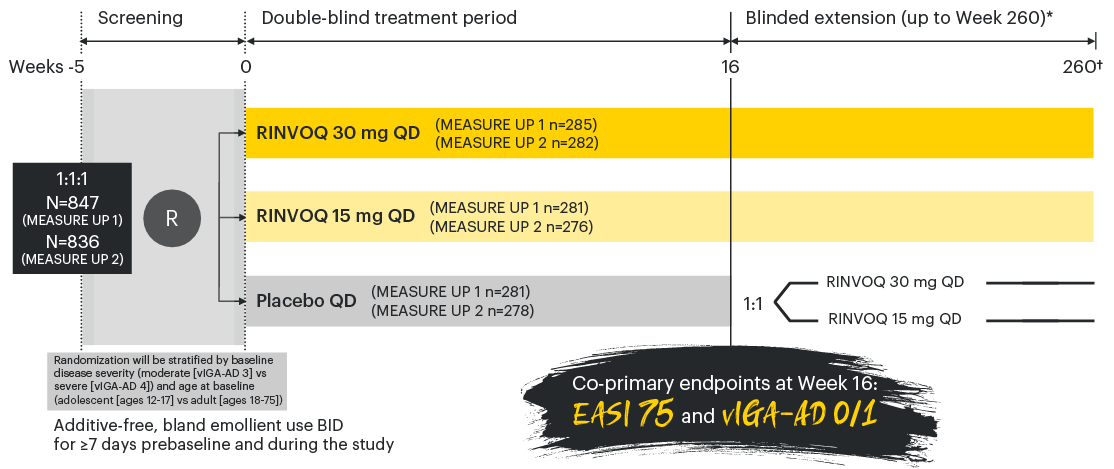
MEASURE UP 1 & 2: Study design1,2
OBJECTIVE: To evaluate the efficacy and safety of RINVOQ monotherapy for the treatment of adolescent (≥12 years of age) and adult subjects with moderate to severe AD who are candidates for systemic therapy. These studies were only vs placebo and were not designed to compare the RINVOQ 15-mg and 30-mg doses against each other
TREATMENT CONSIDERATIONS:
RINVOQ 15 mg QD is the recommended dose for patients at higher risk of VTE, MACE, or malignancy, adolescents 12 to 17 years of age weighing at least 30kg and patients ≥65 years of age. If the adolescent patient does not respond adequately to RINVOQ 15 mg once daily, the dose can be increased to 30 mg once daily. The lowest effective dose to maintain response should be used.1
Efficacy analysis was conducted in the ITT population of the double-blind treatment period, and missing data for the co-primary and ranked secondary endpoints were handled using NRI-C.
*TCS were permitted during the blinded extension period and were not counted as rescue therapy. †30-day follow-up.
MEASURE UP 1 & 2: Co-primary and ranked secondary endpoints1,2
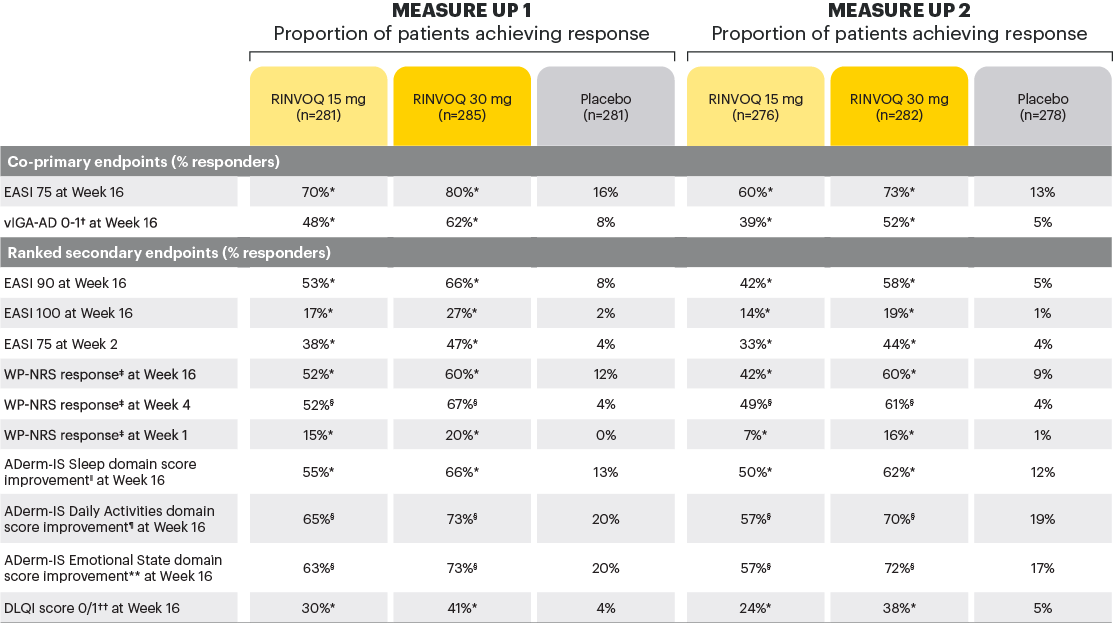
Efficacy analysis was conducted in the ITT population of the double-blind treatment period, and missing data for the co-primary and ranked secondary endpoints were handled using NRI-C.
*P<0.001 vs placebo. †Defined as a vIGA-AD score of 0 (clear) or 1 (almost clear) with ≥2 grades of reduction from baseline. ‡Defined as ≥4-point improvement in WP-NRS from baseline, assessed in patients with a WP-NRS score ≥4 at baseline. §P<0.0001 vs placebo. ǁDefined as ≥12-point improvement in ADerm-IS Sleep domain score, assessed in patients with ADerm-IS Sleep domain score ≥12 at baseline. ¶Defined as ≥14-point improvement in ADerm-IS Daily Activities domain score, assessed in patients with ADerm-IS Daily Activities domain score ≥14 at baseline. **Defined as ≥11-point improvement in ADerm-IS Emotional State domain score, assessed in patients with ADerm-IS Emotional State domain score ≥11 at baseline. ††Assessed in patients ≥16 years of age with DLQI >1 at baseline.
With RINVOQ, you could help maintain minimal disease activity for your patients
Patients on RINVOQ achieved long-term¶¶minimal disease activity for more than 2.5 years2,4,5
MONOTHERAPY | INTEGRATED POST HOC ANALYSIS OF MEASURE UP 1 & 2
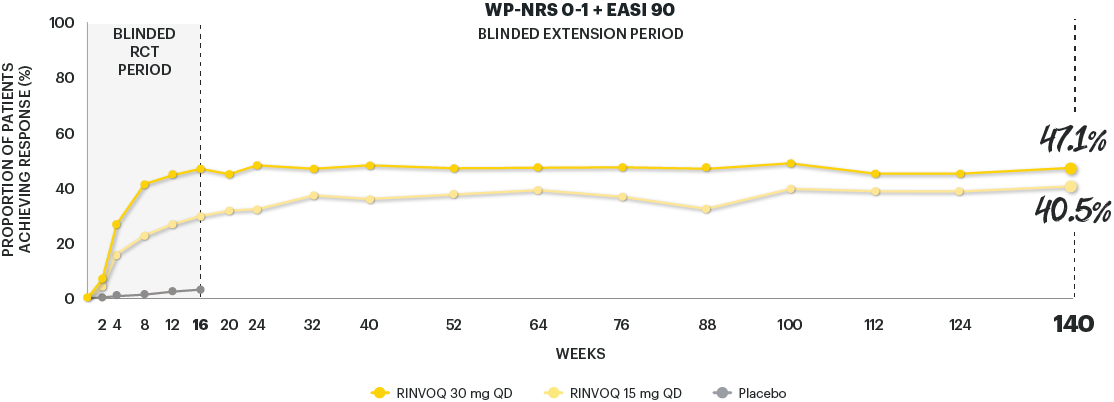
Patients presented: 1213 patients who were randomized to RINVOQ 15 mg (n=603) and RINVOQ 30 mg (n=610) QD monotherapy in MEASURE UP 1 & 2. WP-NRS was assessed in patients with WP-NRS >1 at baseline. At Week 16, patients entered a blinded extension with no placebo control, and patients were aware they were on treatment but blinded to dose.* Click to see the Study Design for further study details.1,2
DATA LIMITATIONS: Data were prespecified, nonranked endpoints not controlled for multiplicity. Observed cases (OC): No imputation of missing data. There is a potential enrichment as patients who are unable to tolerate or do not respond to drug may drop out. Awareness of active treatment may cause bias related to overall treatment effect. TCS use was permitted after Week 4 and was not counted as rescue therapy after Week 16.2,5
*TCS use was permitted during the blinded extension period (starting at the Week 16 visit) and was not counted as rescue therapy.2
¶¶The achievement of WP-NRS 0-1 + EASI 90 is an example of minimal disease activity, defined as simultaneous achievement of optimal treatment targets.4
§§ELEVATE: AbbVie defines "ELEVATE" as the raising of the standards of care in AD patients, measured by WP-NRS and EASI score, treated with Dupilumab vs RINVOQ at week 16 of the head to head trials.6,7


FIND OUT MORE ABOUT RINVOQ
REFERENCES
- RINVOQ® (upadacitinib) Summary of Product Characteristics, available at www.medicines.ie.
- Guttman-Yassky E, Teixeira HD, Simpson EL, et al. Once-daily upadacitinib versus placebo in adolescents and adults with moderate-to-severe atopic dermatitis (Measure Up 1 and Measure Up 2): results from two replicate double-blind, randomised controlled phase 3 trials. Lancet. 2021;397(10290):2151-2168.
- Irvine AD, Silverberg JI, Bunick CG, et al. Efficacy and safety of upadacitinib through 188 weeks in adolescents and adults with moderate-to-severe atopic dermatitis: Phase 3 randomized clinical trial results. Presented at: Revolutionizing Atopic Dermatitis (RAD) 2024 Virtual (Ref DV-013377).
- Silverberg JI, Gooderham M, Katoh N, et al. Combining treat-to-target principles and shared decision-making: international expert consensus-based recommendations with a novel concept for minimal disease activity criteria in atopic dermatitis. J Eur Acad Dermatol Venereol. 2024;38(11):2139-2148.
- Irvine AD, Prajapati VH, Guttman-Yassky E, et al. Efficacy and safety of upadacitinib in patients with moderate-to-severe atopic dermatitis: Phase 3 randomized clinical trial results through 140 weeks. Am J Clin Dermatol. 2025;26(6):1003-1016.
- Silverberg JI, Bunick CG, Hong HC, et al. Efficacy and safety of upadacitinib versus dupilumab in adults and adolescents with moderate-to-severe atopic dermatitis: week 16 results of an open-label randomized efficacy assessor-blinded head-to-head phase Illb/IV study (Level Up). Br J Dermatol. 2024;192(1):36-45.
- Blauvelt A, Teixeira HD, Simpson EL, et al. Efficacy and safety of upadacitinib vs dupilumab in adults with moderate-to-severe atopic dermatitis: a randomized clinical trial. JAMA Dermatol. 2021;157(9):1047-1055.
IE-RNQD-260010 Date of Preparation: May 2026
