



RINVOQ is indicated for the treatment of moderate to severe atopic dermatitis (AD) in adults and adolescents 12 years and older who are candidates for systemic therapy.1
HEADS UP
Consistent safety profile in AD through Week 162
MONOTHERAPY | HEADS UP
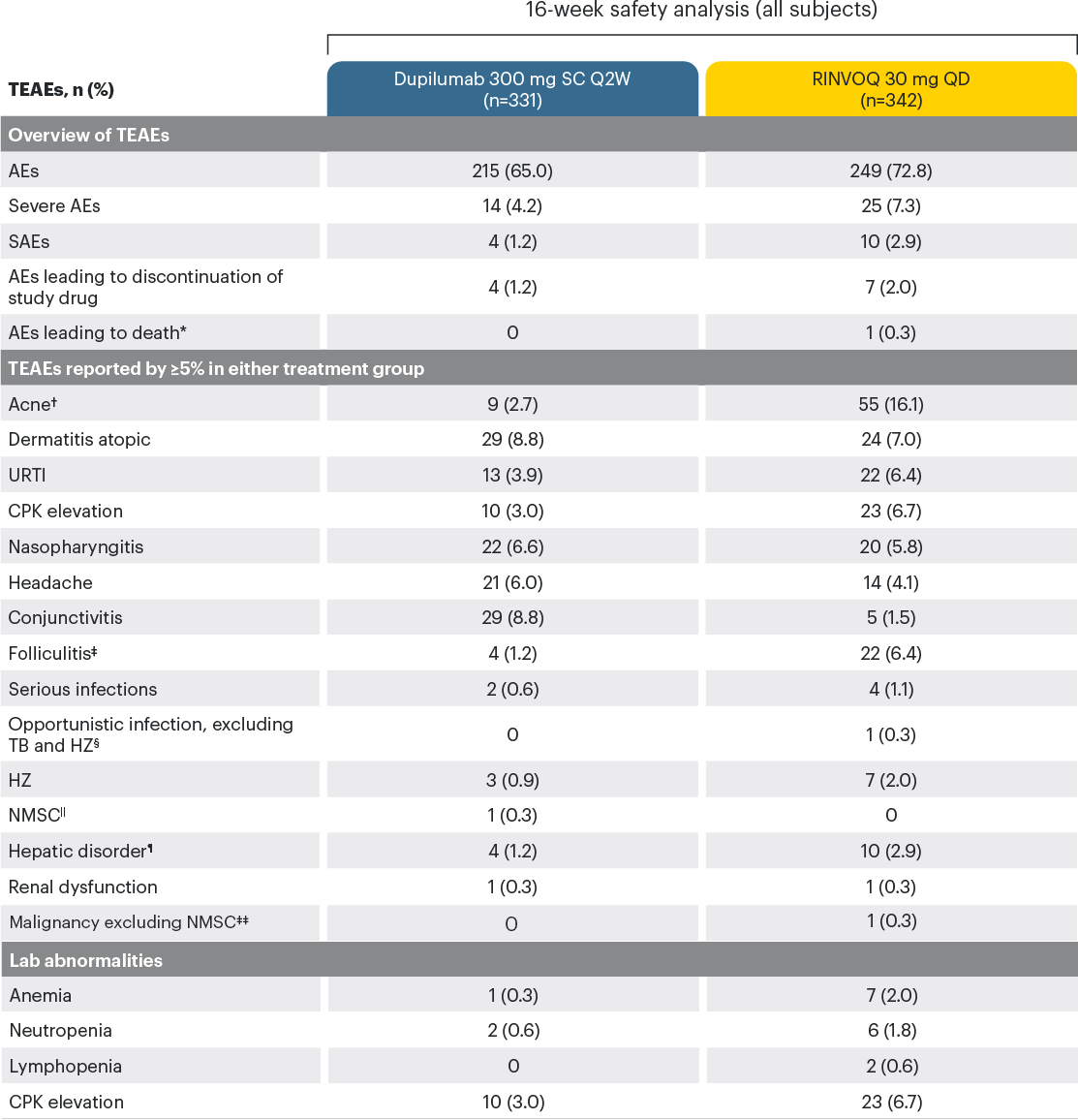
No incidence of active TB, lymphoma, adjudicated GI perforations, adjudicated MACE, or adjudicated VTE were observed across any of the treatment groups.
*A woman 40 years of age was found deceased at home on study Day 70 who had bronchopneumonia associated with influenza A.2 †Most acne events consisted primarily of inflammatory papules, pustules, and comedones, involving the face. All events were nonserious. None led to treatment discontinuation.2 ‡Folliculitis was assessed through the end of the monitoring period, defined as through 30 days following the last dose of RINVOQ or 84 days following the last dose of dupilumab, regardless of any study drug interruption.2 §All opportunistic infections were eczema herpeticum.2 ||Keratoacanthoma: no reasonable possibility of association with the study drug according to the investigator.2 ¶Hepatic disorders: most were elevated transaminases.2 ‡‡ Invasive ductal breast carcinoma, reasonable possibility of relationship to study drug assessed by investigator.
§§ELEVATE: AbbVie defines "ELEVATE" as the raising of the standards of care in AD patients, measured by WP-NRS and EASI score, treated with Dupilumab vs RINVOQ at week 16 of the head to head trials.2,3


FIND OUT MORE ABOUT RINVOQ
REFERENCES
- RINVOQ® (upadacitinib) Summary of Product Characteristics, available at www.medicines.ie.
- Blauvelt A, Teixeira HD, Simpson EL, et al. Efficacy and safety of upadacitinib vs dupilumab in adults with moderate-to-severe atopic dermatitis: a randomized clinical trial. JAMA Dermatol. 2021;157(9):1047-1055.
- Silverberg JI, Bunick CG, Hong HC, et al. Efficacy and safety of upadacitinib versus dupilumab in adults and adolescents with moderate-to-severe atopic dermatitis: week 16 results of an open-label randomized efficacy assessor-blinded head-to-head phase |llb/IVstudy (Level Up). Br J Dermatol. 2024;192(1):36-45.
IE-RNQD-260013 Date of Preparation: May 2026
