

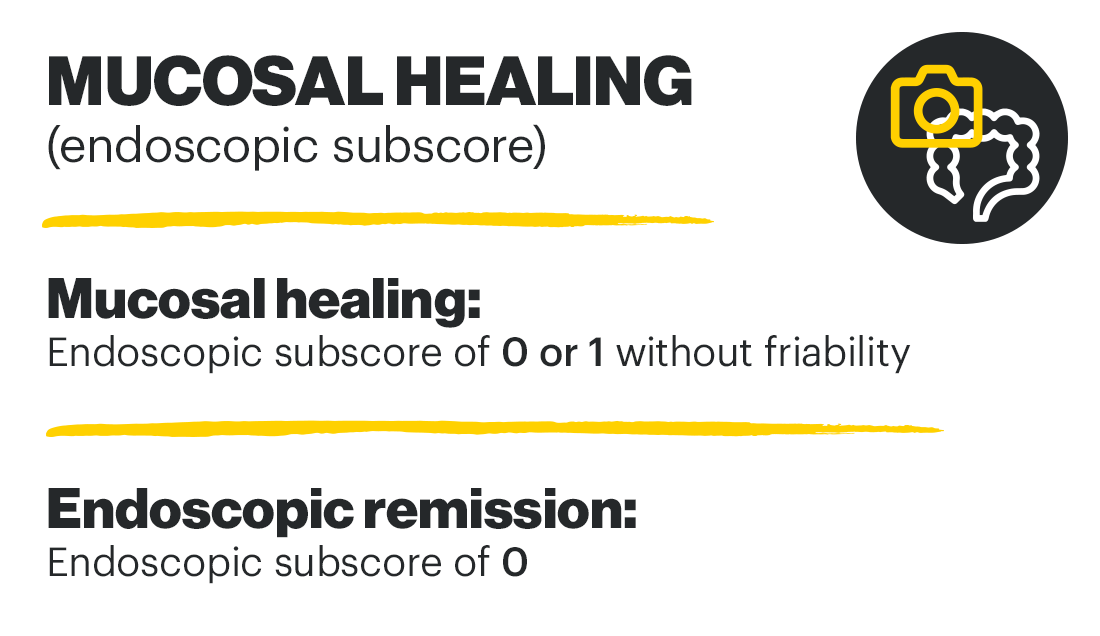
Mucosal healing is a STRIDE-II long-term target of UC treatment.3 In a Phase 3 clinical trial program evaluating the efficacy and safety of RINVOQ in UC, 4 different endpoints were used to measure mucosal healing: mucosal healing, endoscopic remission, histologic-endoscopic mucosal healing and deep mucosal healing.1,2

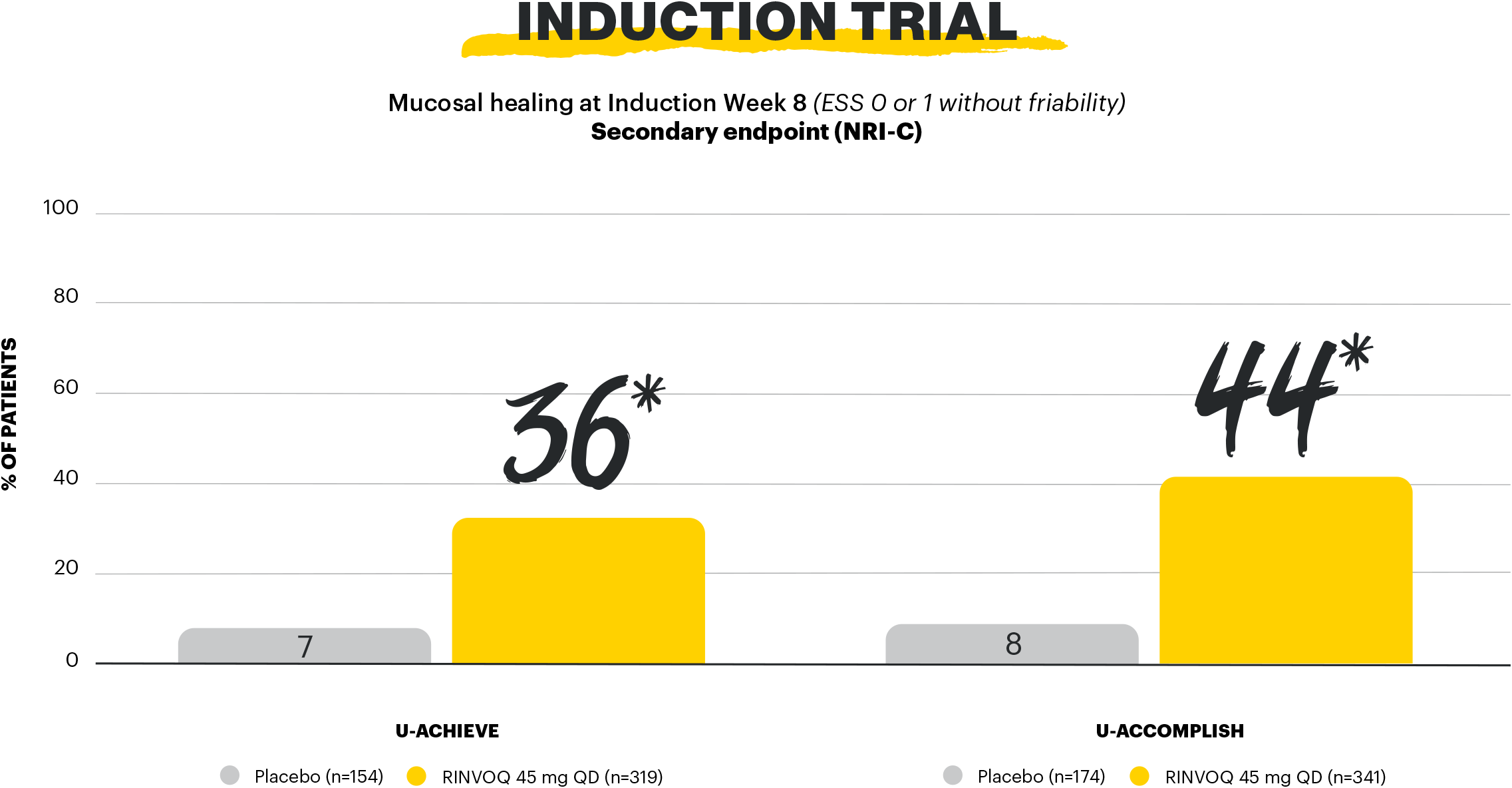
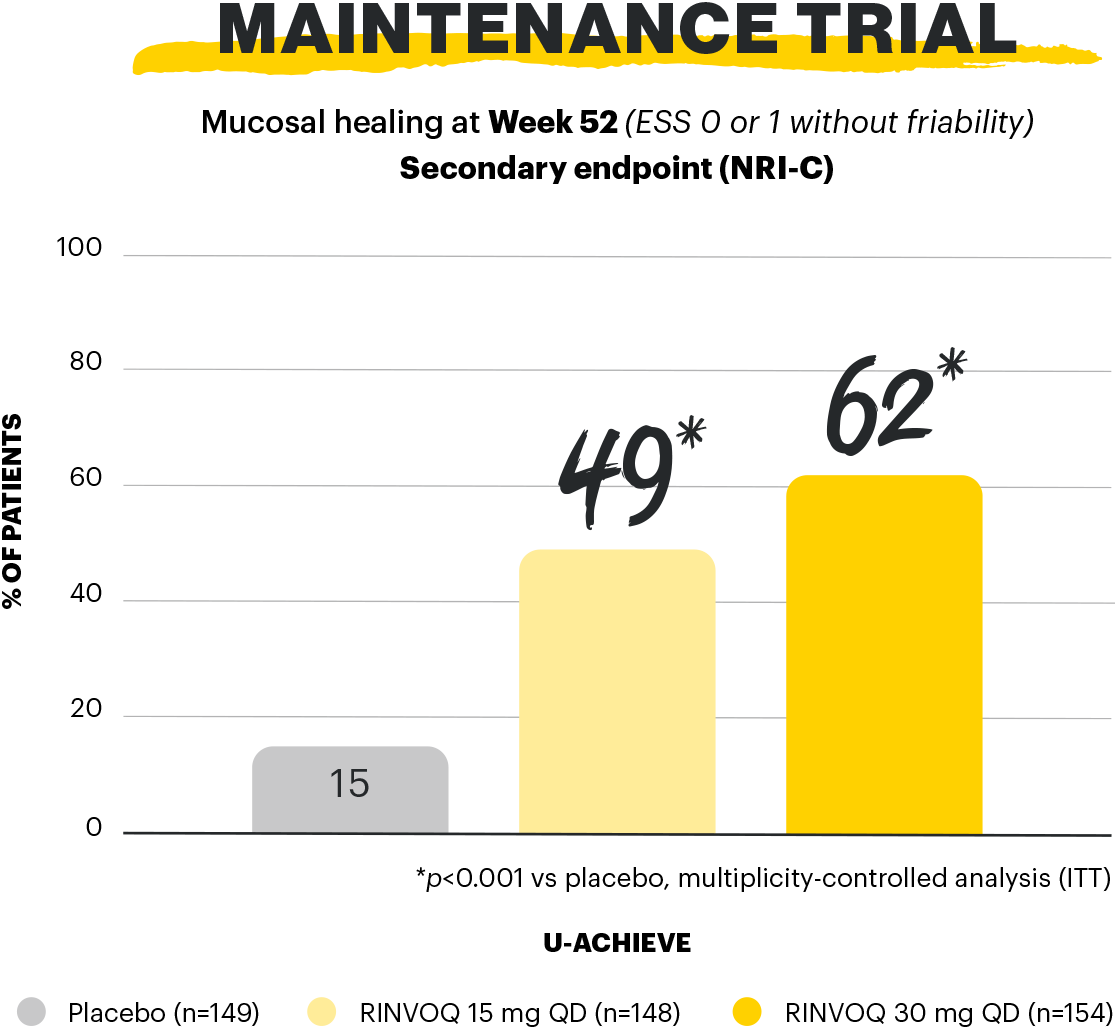
*p<0.001 vs placebo, multiplicity-controlled analysis (ITT)
Mucosal healing at Induction Week 8 and Maintenance Week 52 were ranked secondary endpoints.1,2
Maintenance of mucosal healing at Maintenance Week 52 was a ranked secondary endpoint and was assessed in patients who achieved mucosal healing with 8-week RINVOQ 45 mg induction treatment (n=216).2
Patients who achieved clinical response per adapted Mayo score (decrease ≥2 points and ≥30% from baseline and a decrease in RBS ≥1 from baseline or an absolute RBS ≤1) with 8-week RINVOQ 45 mg QD induction treatment were rerandomized 1:1:1 to receive either RINVOQ 15 mg QD, 30 mg QD or placebo.1,2
Study design: U-ACHIEVE Induction (UC-1) and U-ACCOMPLISH (UC-2) were replicate induction studies, both of which were multicenter, double-blind, placebo-controlled clinical studies. In UC-1 and UC-2, 988 patients (473 and 515 patients, respectively) were randomized to RINVOQ 45 mg QD or placebo for 8 weeks with a 2:1 treatment allocation ratio and included in the efficacy analysis. All enrolled patients had moderately to severely active UC defined as aMs of 5 to 9 with an ESS of 2 or 3 and demonstrated prior treatment failure including inadequate response, loss of response, or intolerance to prior conventional and/or biologic treatment. U-ACHIEVE Maintenance (UC-3) was a multicenter, double-blind, placebo-controlled clinical study with 451 patients who achieved clinical response per aMs (decrease ≥2 points and ≥30% from Baseline and a decrease in RBS ≥1 from Baseline or an absolute RBS ≤1) with 8-week RINVOQ 45 mg QD induction treatment. Patients were rerandomized 1:1:1 to receive either RINVOQ 15 mg QD, 30 mg QD or placebo.1,2
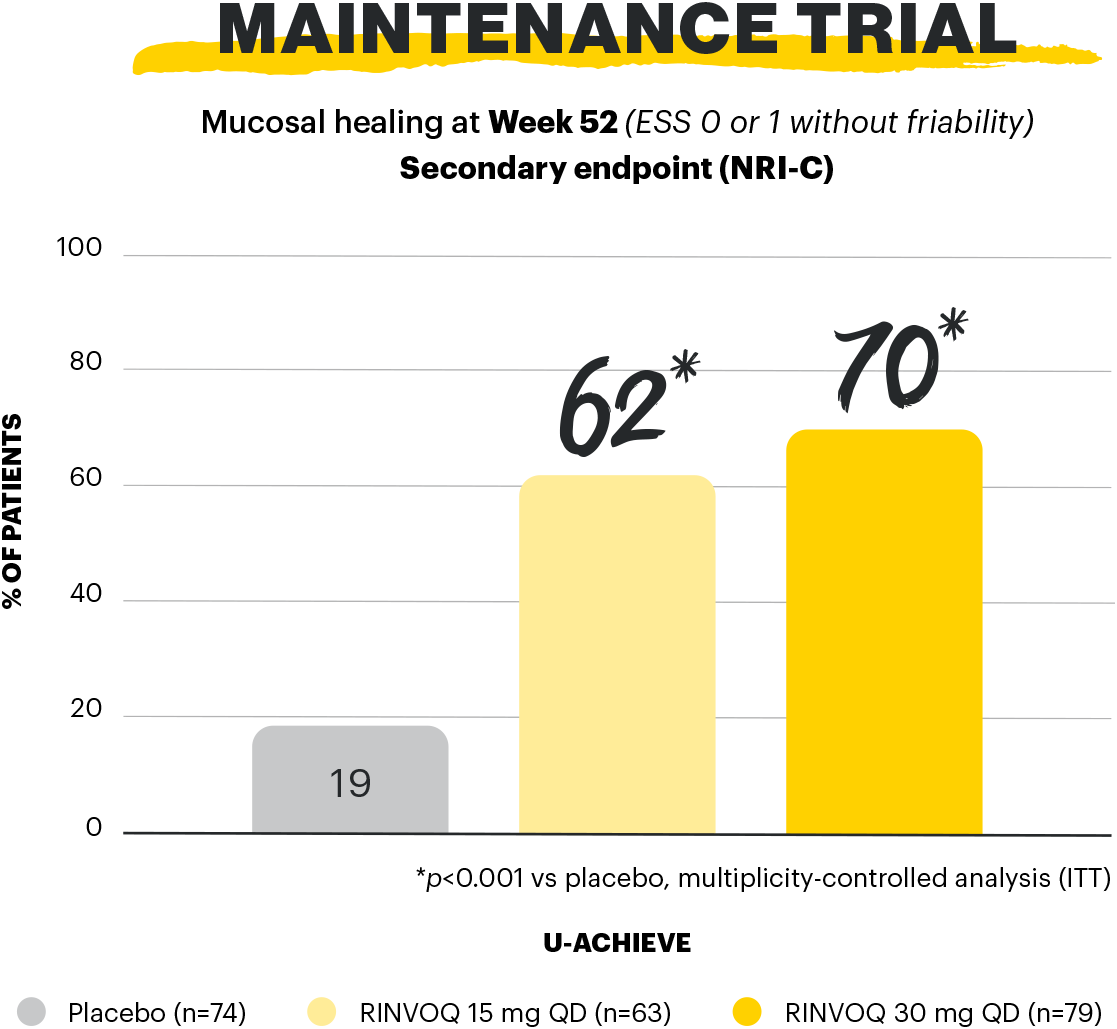
Mucosal healing at Induction Week 8 and Maintenance Week 52 were ranked secondary endpoints.1,2
Maintenance of mucosal healing at Maintenance Week 52 was a ranked secondary endpoint and was assessed in patients who achieved mucosal healing with 8-week RINVOQ 45 mg induction treatment (n=216).2
Patients who achieved clinical response per adapted Mayo score (decrease ≥2 points and ≥30% from baseline and a decrease in RBS ≥1 from baseline or an absolute RBS ≤1) with 8-week RINVOQ 45 mg QD induction treatment were rerandomized 1:1:1 to receive either RINVOQ 15 mg QD, 30 mg QD or placebo.1,2
Study design: U-ACHIEVE Induction (UC-1) and U-ACCOMPLISH (UC-2) were replicate induction studies, both of which were multicenter, double-blind, placebo-controlled clinical studies. In UC-1 and UC-2, 988 patients (473 and 515 patients, respectively) were randomized to RINVOQ 45 mg QD or placebo for 8 weeks with a 2:1 treatment allocation ratio and included in the efficacy analysis. All enrolled patients had moderately to severely active UC defined as aMs of 5 to 9 with an ESS of 2 or 3 and demonstrated prior treatment failure including inadequate response, loss of response, or intolerance to prior conventional and/or biologic treatment. U-ACHIEVE Maintenance (UC-3) was a multicenter, double-blind, placebo-controlled clinical study with 451 patients who achieved clinical response per aMs (decrease ≥2 points and ≥30% from Baseline and a decrease in RBS ≥1 from Baseline or an absolute RBS ≤1) with 8-week RINVOQ 45 mg QD induction treatment. Patients were rerandomized 1:1:1 to receive either RINVOQ 15 mg QD, 30 mg QD or placebo.1,2



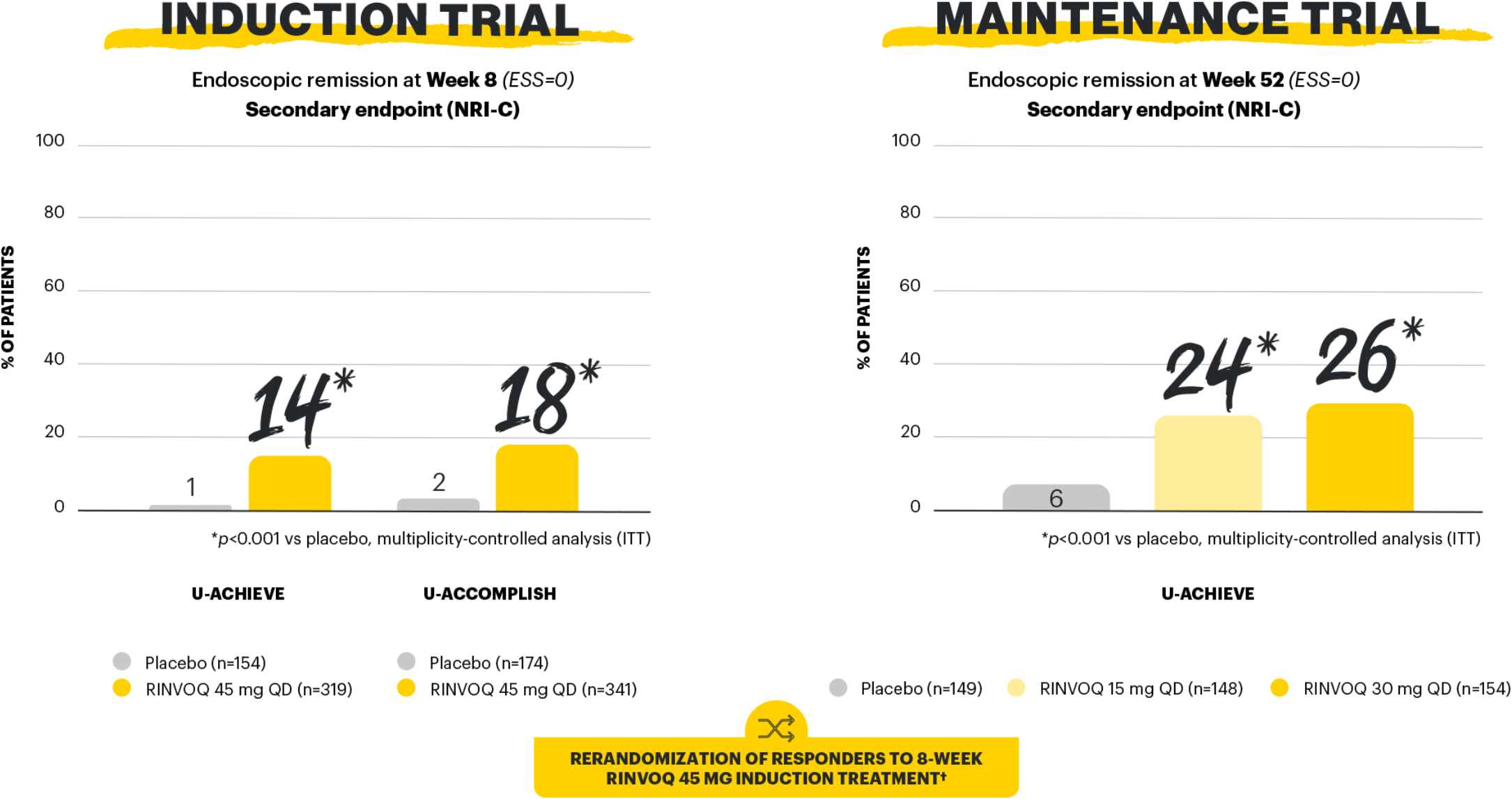
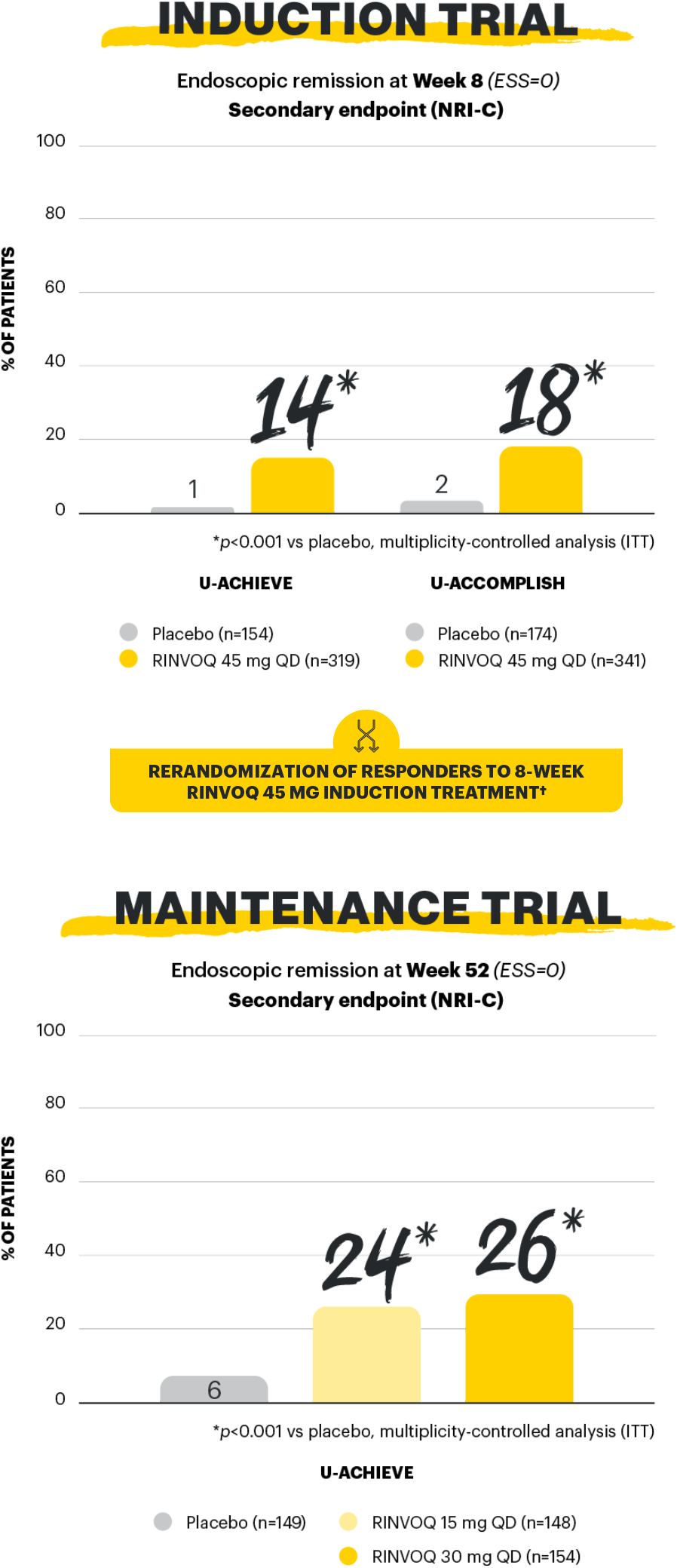
Endoscopic remission at Induction Week 8 and Maintenance Week 52 were ranked secondary endpoints.1,2
†Patients who achieved clinical response per adapted Mayo score (decrease ≥2 points and ≥30% from baseline and a decrease in RBS ≥1 from baseline or an absolute RBS ≤1) with 8-week RINVOQ 45 mg QD induction treatment were rerandomized 1:1:1 to receive either RINVOQ 15 mg QD, 30 mg QD or placebo.1,2
Study design: U-ACHIEVE Induction (UC-1) and U-ACCOMPLISH (UC-2) were replicate induction studies, both of which were multicenter, double-blind, placebo-controlled clinical studies. In UC-1 and UC-2, 988 patients (473 and 515 patients, respectively) were randomized to RINVOQ 45 mg QD or placebo for 8 weeks with a 2:1 treatment allocation ratio and included in the efficacy analysis. All enrolled patients had moderately to severely active UC defined as aMs of 5 to 9 with an ESS of 2 or 3 and demonstrated prior treatment failure including inadequate response, loss of response, or intolerance to prior conventional and/or biologic treatment. U-ACHIEVE Maintenance (UC-3) was a multicenter, double-blind, placebo-controlled clinical study with 451 patients who achieved clinical response per aMs (decrease ≥2 points and ≥30% from Baseline and a decrease in RBS ≥1 from Baseline or an absolute RBS ≤1) with 8-week RINVOQ 45 mg QD induction treatment. Patients were rerandomized 1:1:1 to receive either RINVOQ 15 mg QD, 30 mg QD or placebo.1,2
AE: adverse event; AESI: adverse event of special interest; aMs: adapted Mayo score; CI: confidence interval; CPK: creatine phosphokinase; ESS: endoscopic subscore; GI: gastrointestinal; ITT: intention to treat; MACE: major adverse cardiac event; NMSC: non-melanoma skin cancer; NRI-C: non-responder imputation incorporating multiple imputations to handle missing data due to coronavirus disease 2019 (COVID-19); paMs: partial adapted Mayo score; QD: once-daily; RBS: rectal bleeding score; TEAE: treatment-emergent adverse event; UC: ulcerative colitis; URTI: upper respiratory tract infection; VTE: venous thromboembolism.

Learn from experts in gastroenterology on how you can help deliver mucosal healing for patients with UC, and RINVOQ's rates of mucosal healing in UC through induction and maintenance in its clinical program.1,2

Professor Subrata Ghosh talks about what mucosal healing is, its importance in the management of ulcerative colitis, and why it is a valuable treatment goal to be used in clinical practice.


Professor Remo Panaccione discusses two mucosal healing secondary endpoints (mucosal healing and endoscopic remission) from a recent Phase 3 clinical trial program looking at RINVOQ for the treatment of adults with moderately to severely active UC.
REFERENCES
- RINVOQ Summary of Product Characteristics [DRAFT].
- Danese S, Vermeire S, Zhou W, et al. Lancet. Published online May 26, 2022. doi: https://doi.org/10.1016/S0140-6736(22)00581-5.
- Turner D, Ricciuto A, et al. Gasteroenterology. 2021;160:1570-1583.