

VEN+R safety profile (MURANO trial)
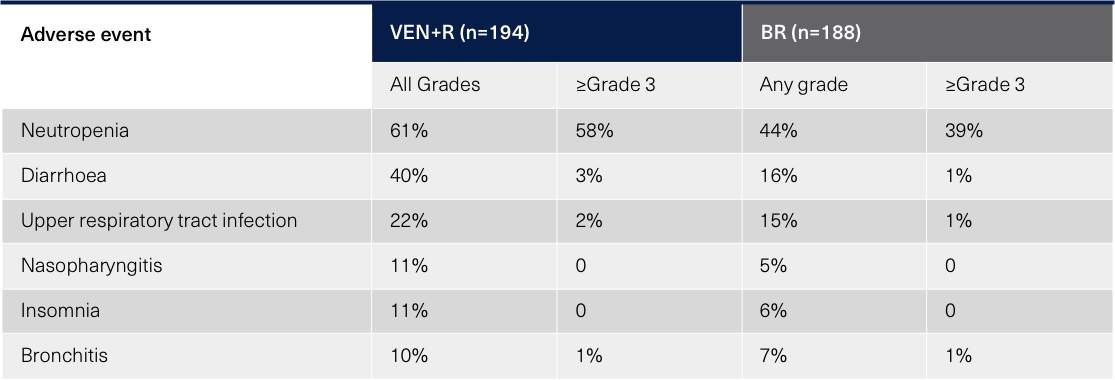
Most common adverse events reported in ≥10% of patients treated with VEN+R and at ≥2% higher incidence VS BR1
Adapted from VENCLEXTA Product Information.1
Median duration of exposure was 22 months in the VEN+R arm and 6 months in the BR arm.1
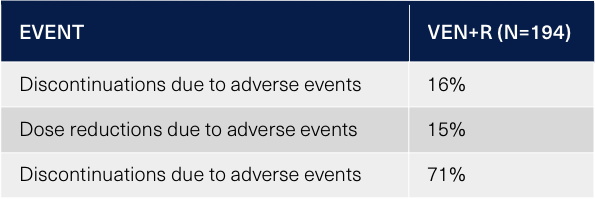
Rate of discontinuations, dose reductions and interruptions due to adverse events1
Adapted from VENCLEXTA Product Information.1
Neutropenia and Infections
Neutropenia is an identified risk associated with VENCLEXTA treatment.1
Complete blood counts should be monitored throughout the treatment period. Dose interruptions or dose reductions are recommended for severe neutropenia. Supportive measures should be considered, including antimicrobials for any signs of infection, and use of growth factors (e.g., granulocyte-colony stimulating factor [G-CSF]).1
Serious infections, including events of sepsis and events with fatal outcome, have been reported in patients treated with VENCLEXTA. Monitor patients for fever and any symptoms of infection and treat promptly. Interrupt dosing as appropriate.1
In the MURANO study, the most common AE leading to VENCLEXTA interruption was neutropenia (43%). 3% of patients discontinued VENCLEXTA due to neutropenia (all grades).1
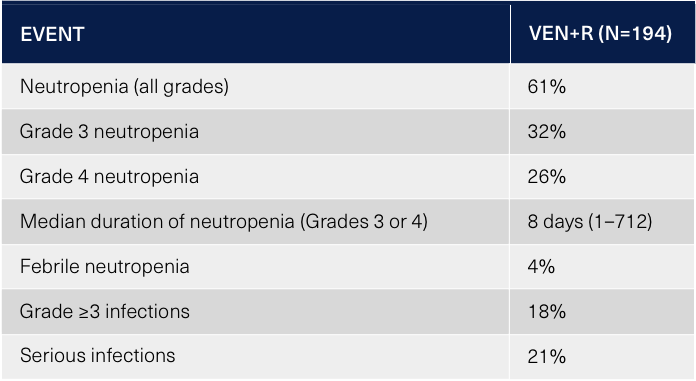
Neutropenia and infections in MURANO trial1
Adapted from VENCLEXTA Product Information.1
Tumour Lysis Syndrome (TLS)
TLS, including life-threatening or fatal events and renal failure requiring dialysis, has occurred in patients treated with VENCLEXTA. It is an important identified risk when initiating VENCLEXTA.1
The risk of TLS is a continuum based on multiple factors including comorbidities, particularly reduced renal function (creatinine clearance [CrCl] <80mL/min) and tumour burden. Splenomegaly may contribute to the overall TLS risk.1
All patients should be assessed for risk and should receive appropriate prophylaxis for TLS, including hydration and anti-hyperuricaemics. Blood chemistries should be monitored and abnormalities managed promptly. Employ more intensive measures (intravenous hydration, frequent monitoring, and hospitalisation) as overall risk increases.1
- After 77 patients were enrolled in the VEN+R or BR treatment arms of the MURANO study, the protocol was amended to incorporate the current TLS prophylaxis and monitoring measures (5-week dose ramp-up schedule)1
- TLS occurred in 3% (6/194) of patients in the VEN+R arm:1
- All events of TLS occurred during dose ramp-up and resolved within two days
- All six patients completed dose ramp-up and reached the recommended daily dose of 400 mg of VENCLEXTA
- No clinical TLS was observed in patients who followed the 5-week dose ramp-up schedule and prophylaxis and monitoring measures
- Grade ≥3 laboratory abnormalities relevant to TLS were: hyperkalaemia (1%), hyperphosphataemia (1%), and hyperuricaemia (1%)1
Please refer to the VENCLEXTA Product Information for full safety information including TLS prophylaxis and monitoring recommendations during initiation and dose ramp-up phase.
Contact
Discover more about how we can help you in your practice.
PBS Information
VENCLEXTA: VENCLEXTA (venetoclax) in combination with rituximab is PBS listed for relapsed or refractory chronic lymphocytlc leukaemia (CLL). VENCLEXTA in combination with obinutuzumab is PBS listed for first line treatment of CLL or small lymphocytic lymphoma (SLL). VENCLEXTA in combination with ibrutinib is indicated for the treatment of adult patients with previously untreated chronic lymphocytic leukaemia/small lymphocytic lymphoma (CLL/SLL). VENCLEXTA in combination with azacitidine is PBS listed for treatment of acute myeloid leukaemia (AML). General Schedule listing. Authority required (telephone). Refer to PBS schedule for full authority information, VENCLEXTA monotherapy is not listed on the PBS. VENCLEXTA in combination with low-dose cytarabine is not listed on the PBS for treatment of AML.
Please review the full Product Information (PI) before prescribing, available below.
BR: bendamustine + rituximab. R: rituximab. TLS: tumour lysis syndrome. VEN: VENCLEXTA.
References: 1. VENCLEXTA Product Information.
AU-VENC-210044 Last revised September 2022