



Previous
Next
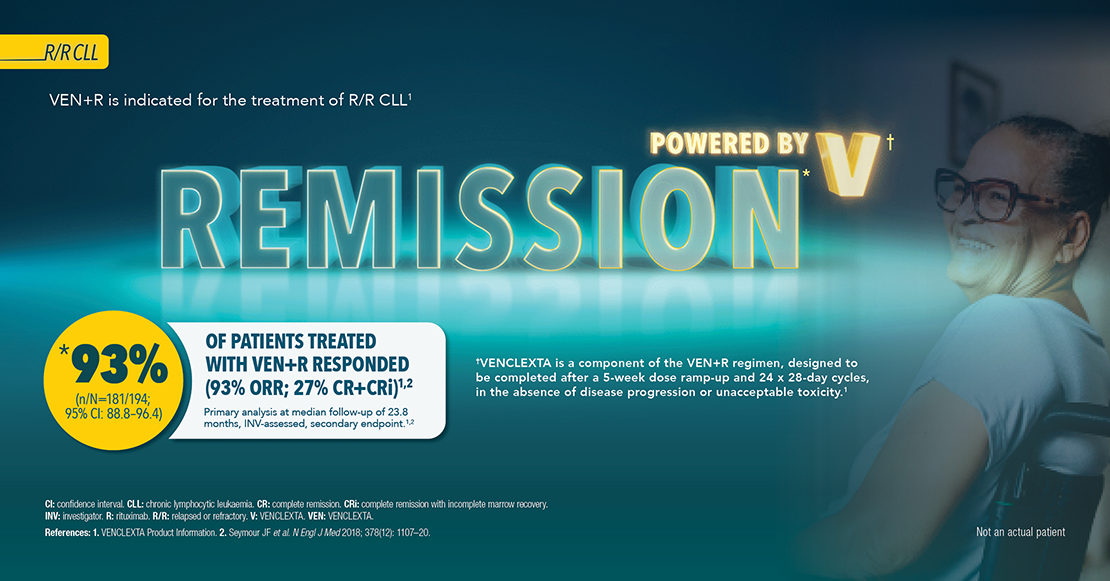
VENCLEXTA + rituximab in R/R CLL
KEY DATA
PBS listed:
VENCLEXTA in combination with rituximab is PBS listed for certain patients with relapsed or refractory CLL.1
Visit www.pbs.gov.au for full criteria.

Deep
Response#
#Of 130 patients who completed VEN+R without progression: 64% (n=83) achieved peripheral blood uMRD at end of therapy (<1 CLL cell/10,000 leukocytes) and 51.1% (95% CI: 40.2% to 61.9%) remained progression-free following 36 months of treatment.2,3

Fixed Treatment Duration‡
‡24-month VENCLEXTA treatment duration (24 x 28-day cycles) following
a 5‐week dose ramp-up period.4

A Well Characterised Safety Profile§
§The most commonly occurring adverse events (≥20%) of any grade in patients receiving VEN+R were neutropenia, diarrhoea, thrombocytopenia and pyrexia.2,4 Refer to the Product Information for full safety information.2
DOWNLOADABLE RESOURCES
Initiating VENCLEXTA

PBS Code Summary for VENCLEXTA in 1L and R/R CLL
A summary of the PBS Codes for initiating VENCLEXTA in combination with obinutuzumab (1L CLL) or rituximab (R/R CLL).

Patient information brochure for VENCLEXTA + rituximab treatment (R/R CLL)
Download this resource to help educate and support your R/R CLL patients starting VENCLEXTA + rituximab treatment.
SELF SERVICE
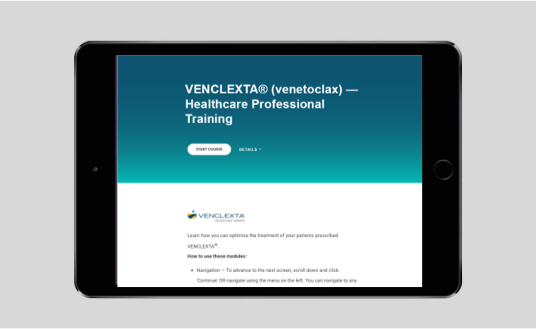
HCP training: How to optimise VENCLEXTA treatment
Practical online training to help you get confident with managing patients prescribed VENCLEXTA.
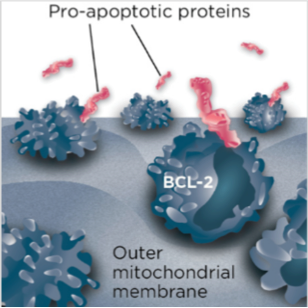
In the late 1980s, pioneering Australian research identified that the BCL-2 protein was involved in cancer cell survival.6 Decades later,
the fruits of this ground-breaking research resulted in the development of VENCLEXTA, a selective BCL-2 inhibitor that restores
the process of apoptosis in malignant CLL cells.4,7
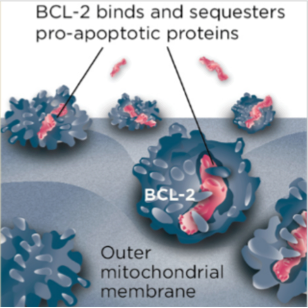
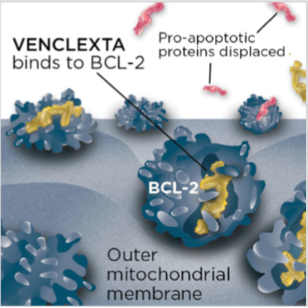
In R/R CLL, VENCLEXTA is used in combination with rituximab, a monoclonal antibody that targets the CD20 antigen expressed on the surface of pre-B and mature B-lymphocytes.4,8
This combination of non-overlapping mechanisms of action was more effective than either agent alone in inducing tumour growth delay and increasing cell death in preclinical cell models.7,9††
††Based on in vitro preclinical studies, which do not necessarily correlate with clinical outcomes.
Venetoclax is an anti-cancer treatment that was discovered by scientists from AbbVie, as part of an international collaboration with the Walter and Eliza Hall Institute of Medical Research and Genentech, a member of the Roche Group.
Contact
Discover more about how we can help you in your practice.
PBS Information
VENCLEXTA: VENCLEXTA (venetoclax) in combination with rituximab is PBS listed for relapsed or refractory chronic lymphocytlc leukaemia (CLL). VENCLEXTA in combination with obinutuzumab is PBS listed for first line treatment of CLL or small lymphocytic lymphoma (SLL). VENCLEXTA in combination with ibrutinib is indicated for the treatment of adult patients with previously untreated chronic lymphocytic leukaemia/small lymphocytic lymphoma (CLL/SLL). VENCLEXTA in combination with azacitidine is PBS listed for treatment of acute myeloid leukaemia (AML). General Schedule listing. Authority required (telephone). Refer to PBS schedule for full authority information, VENCLEXTA monotherapy is not listed on the PBS. VENCLEXTA in combination with low-dose cytarabine is not listed on the PBS for treatment of AML.
Please review the full Product Information (PI) before prescribing, available below.
CLL: chronic lymphocytic leukaemia. HCP: healthcare professional. R: rituximab. R/R CLL: relapsed or refractory CLL. TLS: tumour lysis syndrome
References: 1. Australian Government Department of Health. Schedule of Pharmaceutical Benefits, www.pbs.gov.au Accessed September 2021. 2. Kater AP et al. J Clin Onc 2019; 37(4): 269–77. 3. Kater AP et al. Five-year analysis of MURANO study demonstrates enduring undetectable minimal residual disease (uMRD) in a subset of relapsed/refractory chronic lymphocytic leukemia (R/R CLL) patients (pts) following fixed-duration venetoclax-rituximab (VenR) therapy (Tx). Oral presentation presented at: 62nd American Society of Hematology (ASH) Annual Meeting and Exposition; 5–8 December 2020; Virtual meeting. 4. VENCLEXTA Product Information. 5. Seymour JF et al. N Engl J Med 2018; 378(12): 1107–20 (Supplementary Appendix). 6. Vaux DL et al. Nature 1988; 335(6189): 440–2. 7. Souers AJ et al. Nat Med 2013; 19(2): 202–8. 8. MabThera (rituximab) Product Information. 9. Thijssen R et al. Haematologica 2015; 100(8): e302–6.
AU-VENC-210042 Last revised September 2023