

Affiliates to localise according to local regulations: addition of the recent indication:
Active non-radiographic axial spondyloarthritis
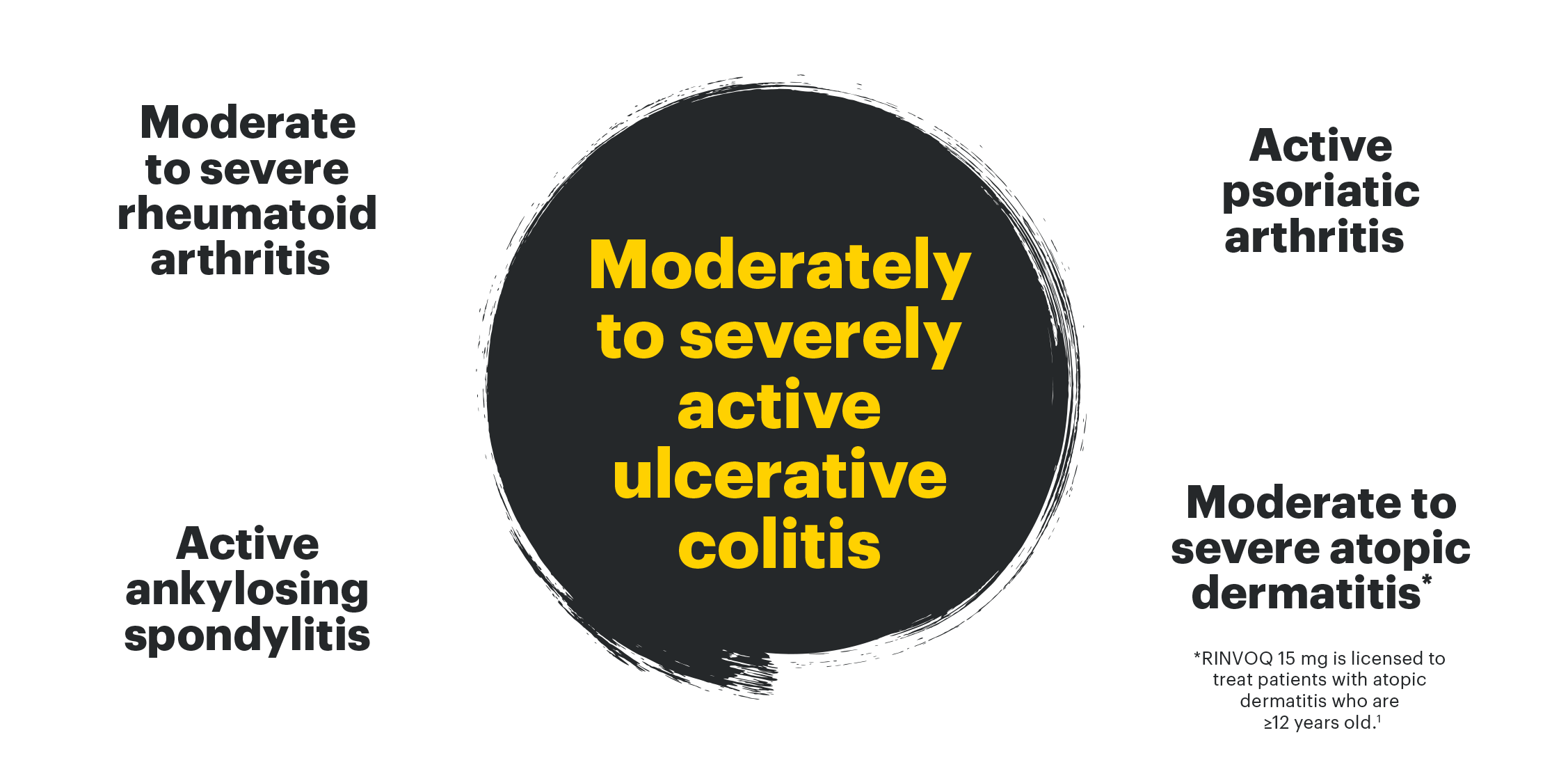
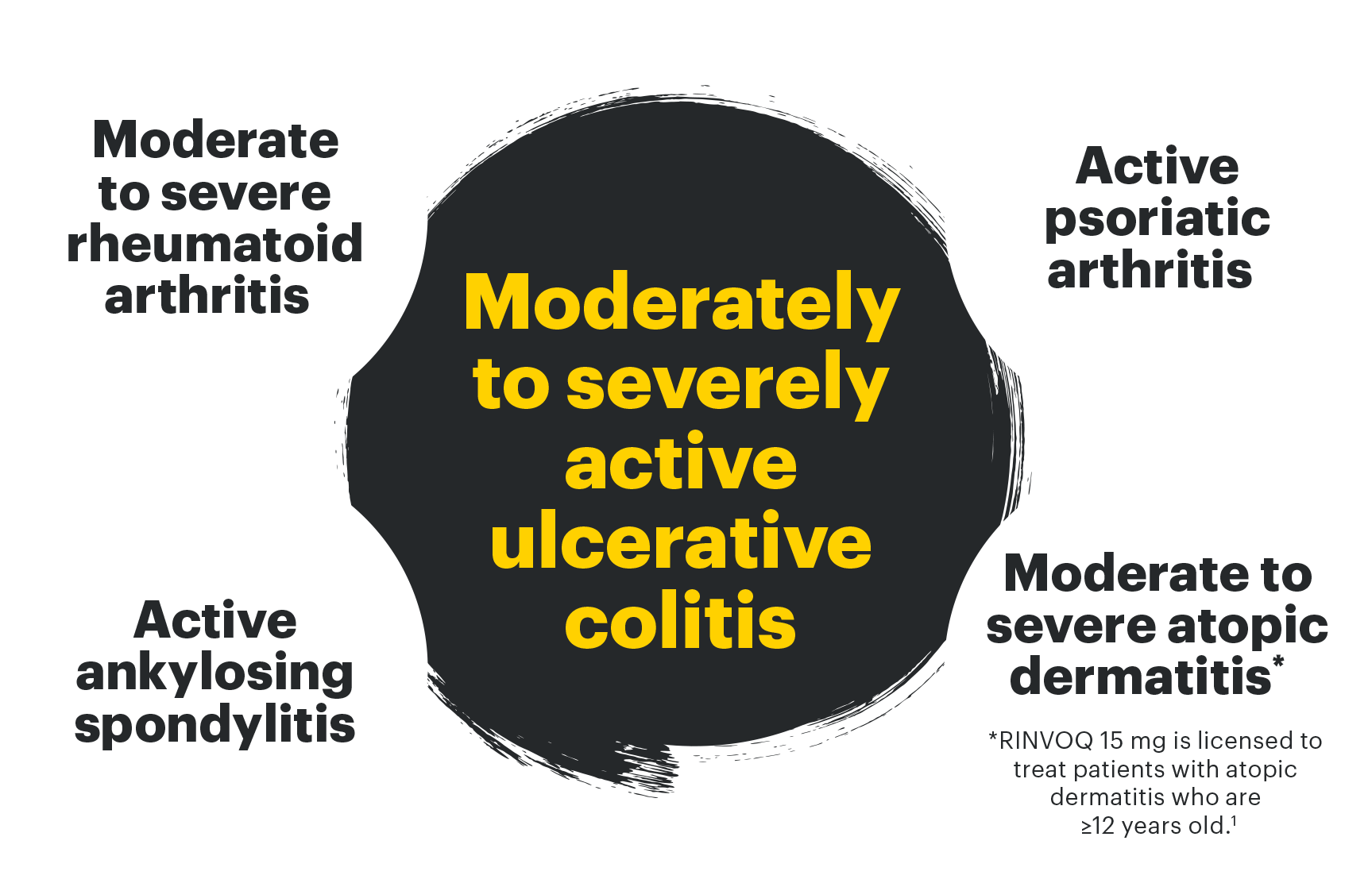
Affiliates to localise according to local regulations: addition of recent nr-axSpA indication and related reference:
Deodhar A, Van den Bosch F, Poddubnyy D, et al. Upadacitinib for the Treatment of Active Non-Radiographic Axial Spondyloarthritis (SELECT-AXIS 2): A Randomised, Double-Blind, Placebo-Controlled Phase 3 Trial. [DRAFT Manuscript]


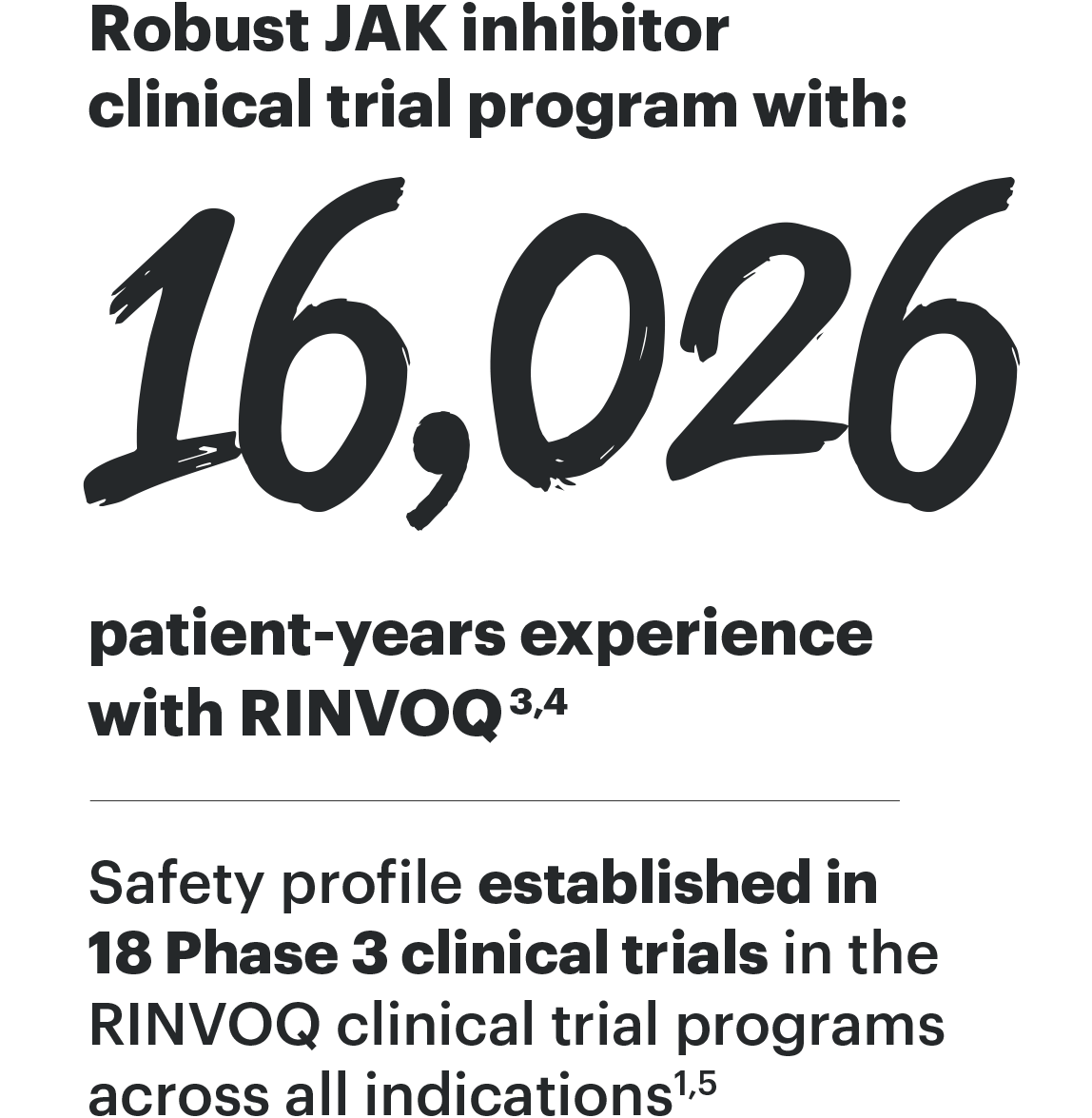
2 TRIALS IN UC: Consisting of 3 Phase 3 studies: U‑ACHIEVE Induction U‑ACCOMPLISH (Induction); and U‑ACHIEVE Maintenance

8 TRIALS IN RA: SELECT‑EARLY, SELECT‑NEXT, SELECT‑COMPARE, SELECT‑MONOTHERAPY, SELECT‑BEYOND, SELECT‑CHOICE, SELECT‑SUNRISE, SELECT‑CHINA

2 TRIALS IN PsA: SELECT‑PsA 1,
SELECT‑PsA 2

1 TRIAL IN AS: SELECT‑AXIS 1

5 TRIALS IN AD: RISING‑UP, MEASURE‑UP 1, MEASURE‑UP 2, AD‑UP, HEADS‑UP


Overview of AE rates per 100 PYs with RINVOQ 15 mg and 30 mg
Objective: This assessment reviewed safety data for RINVOQ maintenance therapy in UC in the context of the known long-term safety profile of RINVOQ in its approved indications.

Table amended from Colombel et al. 2022; not all treatment arms are shown here.
*Patients who were RINVOQ 45 mg QD 8-week induction responders and were enrolled into maintenance treatment for 44 or 52 weeks. †Includes two Phase 3 studies; includes adults and adolescents. ‡Includes six Phase 3 studies; may include patients receiving concomitant methotrexate. §Includes two Phase 3 studies.


With RINVOQ maintenance treatment in UC through 52 weeks
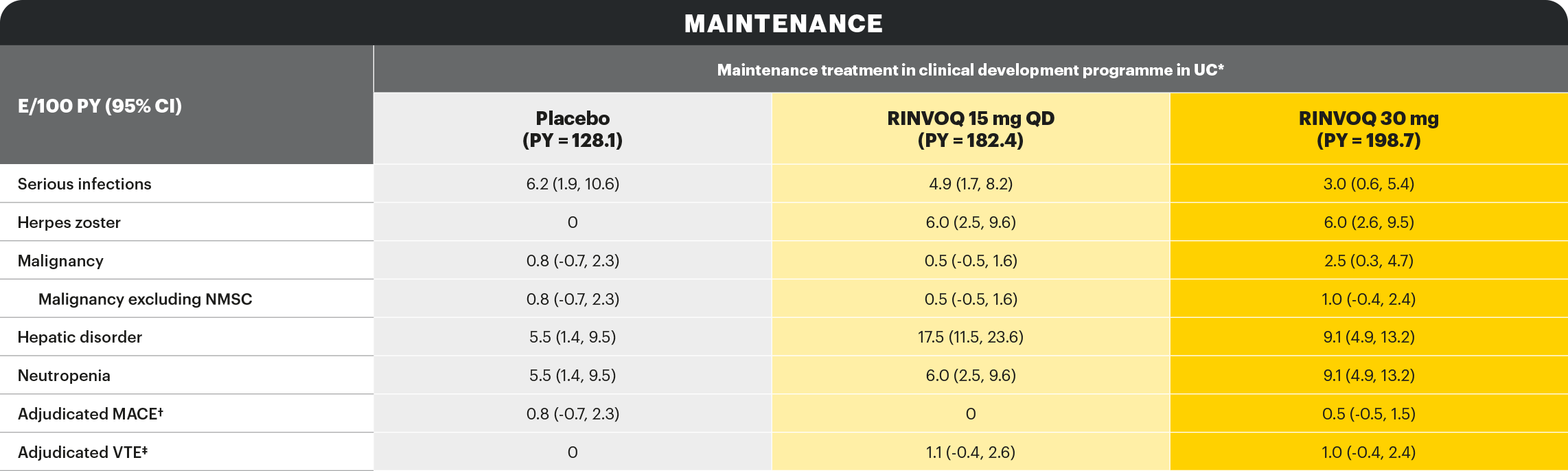
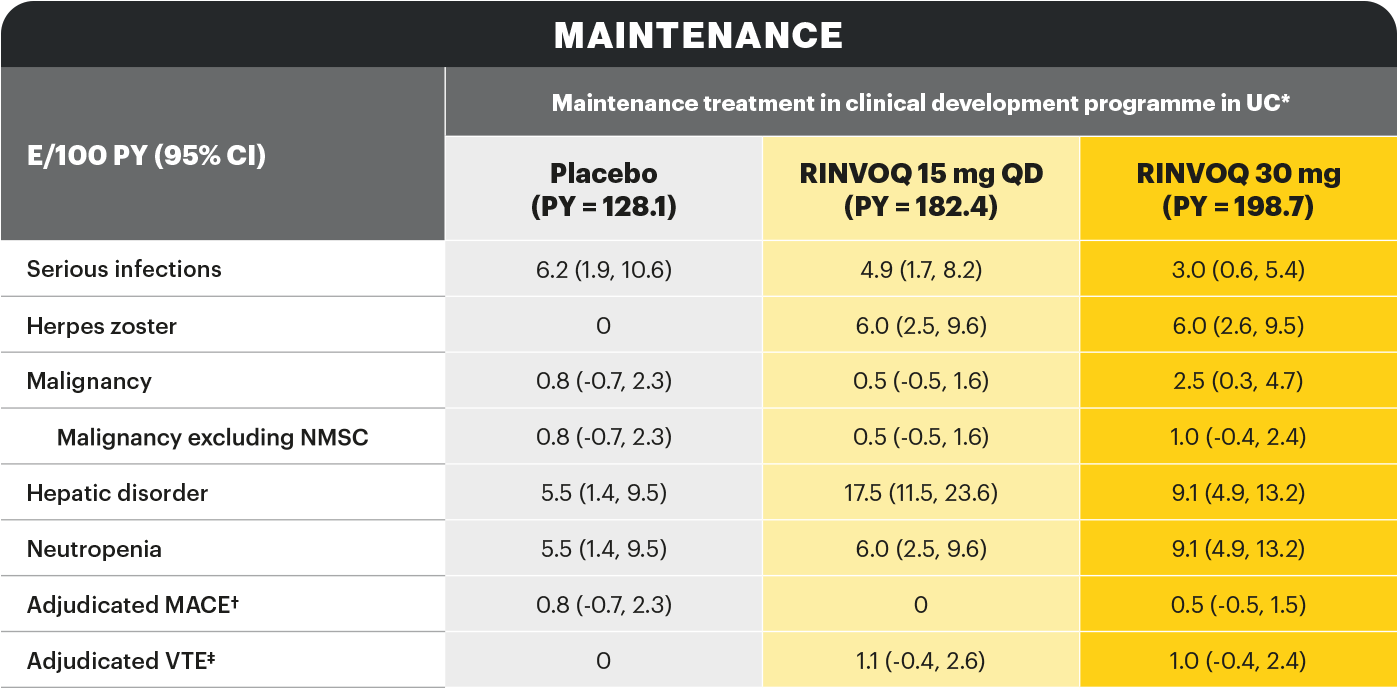
AEs of special interest were pre-specified based on previous studies with RINVOQ or other JAK inhibitors, eg, serious infection, herpes zoster, malignancy, MACEs and VTEs. MACEs and VTEs were adjudicated by an independent external adjudication committee.
*Patients who were RINVOQ 45 mg QD 8-week induction responders and were enrolled under the protocol for 44 or 52 weeks’ maintenance treatment. †Defined as cardiovascular death, non-fatal myocardial infarction and non-fatal stroke. ‡Defined as deep vein thrombosis and pulmonary embolism (fatal and non-fatal).




Patients who completed Period 1 of SELECT-AXIS 1 (up to Week 14) were eligible to enter Period 2 and receive open-label RINVOQ 15 mg QD for 90 weeks, up to week 104. Reported here are results at Week 64 (cutoff date January 31, 2020), when all ongoing patients had reached the Week-64 visit and had at least 52 weeks of RINVOQ exposure, including in the placebo-to-RINVOQ switch group.4
The most common adverse event with RINVOQ through Week 14 was increased creatine phosphokinase.7 No serious infections, active tuberculosis, venous thromboembolic events, gastrointestinal perforation, major adverse cardiovascular events, renal dysfunction, or deaths were reported. *Cardiovascular disorder, reported as mild circulation dysregulation. †Spinal osteoarthritis, reported as moderate worsening of cervical spondylosis 4/5. ‡Dyspepsia (n=1), blood creatine phosphokinase increased (n=1), and atlantoaxial instability (n=1). §Otitis media (n=1) and myalgia (n=1). ¶Esophageal candidiasis in patient with gastro-esophageal reflux disease; study drug continued after treatment with fluconazole. ¥Including non-melanoma skin cancer, malignancy other than non-melanoma skin cancer, and lymphoma. #All seven hepatic disorders were based on asymptomatic alanine aminotransferase or aspartate aminotransferase increases, and none led to premature discontinuation of study drug. **All asymptomatic except for one patient in the placebo group. ††Two non-serious events of esophageal candidiasis in the same patient. ‡‡Five events in four patients; all non-serious and limited to one dermatome. ##Majority based on asymptomatic alanine aminotransferase/aspartate aminotransferase elevations; all were non-serious and none led to study drug discontinuation. §§All events were nonserious and none led to study drug discontinuation. ¥¥Squamous cell carcinoma of tongue in 61-year old former smoker; no reasonable possibility to be study drug related per investigator.



The overall safety profile of RINVOQ observed in patients with ulcerative colitis was generally consistent with that observed in patients with rheumatoid arthritis.1,2
aSELECT-EARLY, SELECT-COMPARE, SELECT-MONOTHERAPY, SELECT-NEXT, SELECT-BEYOND, and SELECT-CHOICE.
The most common AEs for RINVOQ 15 mg QD in the RA integrated safety analysis were upper respiratory tract infection, nasopharyngitis, and urinary tract infection.
*In RA studies, patients who switched from placebo, adalimumab, MTX, or abatacept to RINVOQ were included in the RINVOQ analysis set from the start of RINVOQ, while those who switched from RINVOQ to adalimumab were included in the adalimumab analysis set from the start of adalimumab and were censored at the time of switch. MTX monotherapy was censored at time of rescue to combination therapy (addition of RINVOQ).
§Both treatment and non–treatment-emergent deaths. IIMACE defined as cardiovascular death, nonfatal myocardial infarction, and nonfatal stroke. ¶VTE defined as deep vein thrombosis and pulmonary embolism.


Treatment-emergent adverse events and exposure-adjusted event rates (events/100PY) during RINVOQ administration (safety population, combined data, MEASURE UP 1 & 2)


At Week 16, patients receiving RINVOQ 15 mg or 30 mg during the double-blind period continued their assigned treatment in the blinded extension period, whereas patients receiving placebo were rerandomized 1:1 to receive RINVOQ 15 mg or 30 mg in the blinded extension period.


At Week 16, patients receiving RINVOQ 15 mg or 30 mg during the double-blind period continued their assigned treatment in the blinded extension period, whereas patients receiving placebo were rerandomized 1:1 to receive RINVOQ 15 mg or 30 mg in the blinded extension period. *Eczema herpeticum or Kaposi’s varicelliform eruption.


*Excluding tuberculosis and herpes zoster. †MACE was defined as cardiovascular death, non-fatal myocardial infarction and non-fatal stroke. ‡VTE was defined as deep vein thrombosis and pulmonary embolism.
AE: adverse event; AESI: adverse event of special interest; aMs: adapted Mayo score; CI: confidence interval; CPK: creatine phosphokinase; ESS: endoscopic subscore; GI: gastrointestinal; ITT: intention to treat; MACE: major adverse cardiac event; NMSC: non-melanoma skin cancer; NRI-C: non-responder imputation incorporating multiple imputations to handle missing data due to coronavirus disease 2019 (COVID-19); paMs: partial adapted Mayo score; QD: once-daily; RBS: rectal bleeding score; TEAE: treatment-emergent adverse event; UC: ulcerative colitis; URTI: upper respiratory tract infection; VTE: venous thromboembolism.

RINVOQ is an oral, once daily, selective and reversible JAK inhibitor now approved for the treatment of adult patients with moderately to severely active ulcerative colitis who have had an inadequate response, lost response or were intolerant to either conventional therapy or a biologic agent.1
RINVOQ can be taken at any time of the day, with or without food.1
A Phase 3 clinical trial program involving 3 studies: 2 replicate induction studies and 1 maintenance study evaluated RINVOQ 45 mg vs placebo for induction, and RINVOQ 15 mg and 30 mg vs placebo for maintenance treatment.



Learn more about RINVOQ’s safety profile during a Phase 3 8-week induction and 52-week maintenance clinical study program.


RINVOQ ISI PLACEHOLDER
and
HUMIRA ISI PLACEHOLDER and link to HUMIRA SmPC
REFERENCES
- RINVOQ Summary of Product Characteristics.
- Danese S, Vermeire S, Zhou W, et al. Lancet. 2022;399(10341):2113–2128.
- Colombel JF, Panaccione R, Nakase H, et al. Abstract presented at the 17th Congress of the European Crohn’s and Colitis Organization (ECCO 2022), 16–19 February 2022, Vienna, Austria. P573.
- Deodhar A, van der Heijde D, Sieper J, et al. Arthritis Rheumatol. 2022;74(1):70–80.
- AbbVie Data on File: Clinical Trials upadacitinib.
- AbbVie news. AbbVie Receives FDA Approval of RINVOQ™ (upadacitinib), an Oral JAK Inhibitor For The Treatment of Moderate to Severe Rheumatoid Arthritis. Available at: https://news.abbvie.com/alert-topics/immunology/abbvie-receives-fda-approval-rinvoq-upadacitinib-an-oral-jak-inhibitor-for-treatment-moderate-to-severe-rheumatoid-arthritis.htm. Accessed: August 2022.
- Van der Heijde D, Song IH, Pangan AL, et al. Lancet. 2019; 394(10214):2108–2117.
- Cohen SB, van Vollenhoven R, Curtis JR, et al. 2021 EULAR E-Congress; POS0220.
- Simpson EL, Papp KA, Blauvelt A, et al. Efficacy and safety of upadacitinib in patients with moderate to severe atopic dermatitis: analysis of follow up data from the Measure Up 1 and Measure Up 2 randomized clinical trials. JAMA Dermatol. 2022;158(4):404–413. doi:10.1001/jamadermatol.2022.0029.
- Burmester GR, Winthrop K, Blanco R, et al. Rheumatol Ther. 2022;9(2):521–539.