



RINVOQ is an oral, once-daily, selective and reversible JAK inhibitor now approved for the treatment of adult patients with moderately to severely active ulcerative colitis who have had an inadequate response, lost response or were tolerant to either conventional therapy or a biologic agent.1
RINVOQ can be taken at any time of the day, with or without food.1
A Phase 3 clinical trial program involving 3 studies: 2 replicate induction studies and 1 maintenance study evaluated RINVOQ 45 mg vs placebo for induction, and RINVOQ 15 mg and 30 mg vs placebo for maintenance treatment.
Learn more about RINVOQ in our quick introductory video.


Clinical response per partial adapted Mayo score, also known as symptomatic response*
Clinical response per partial adapted Mayo score (Symptomatic response): defined as a decrease in partial adapted Mayo score ≥1 point and a ≥30% from baseline, PLUS a decrease in rectal bleeding score ≥1 or an absolute rectal bleeding score ≤1.1,2

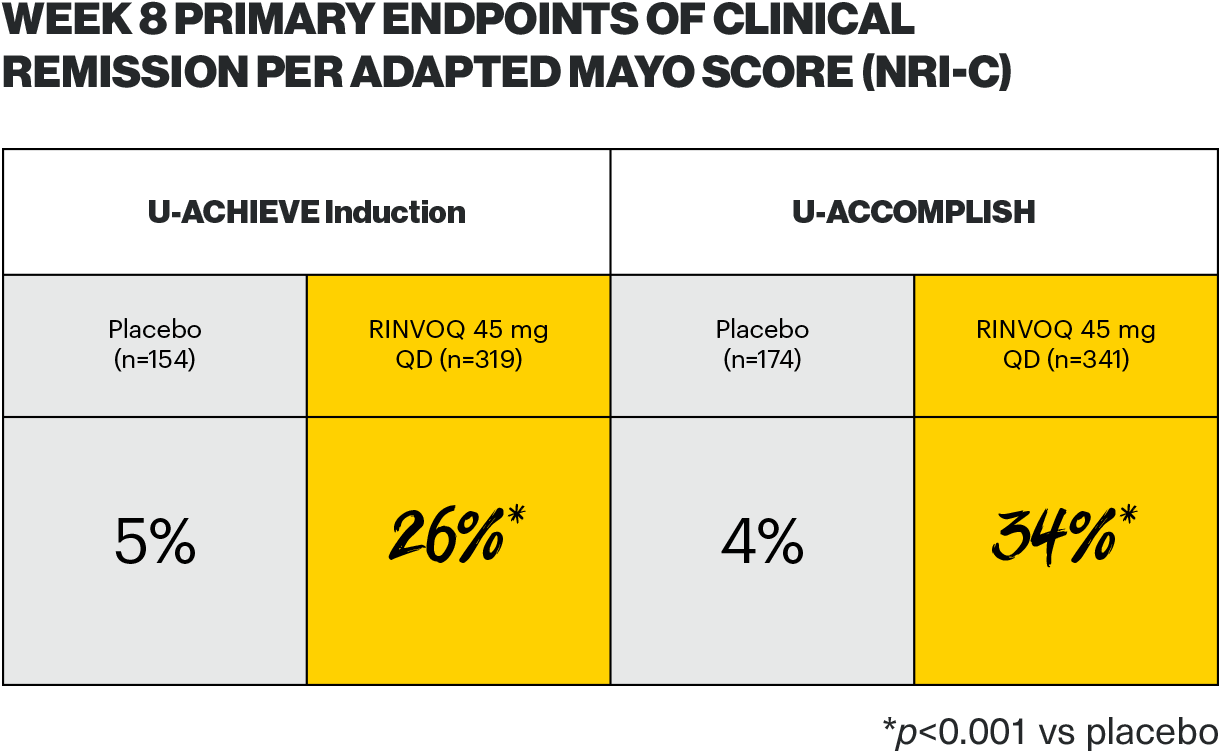
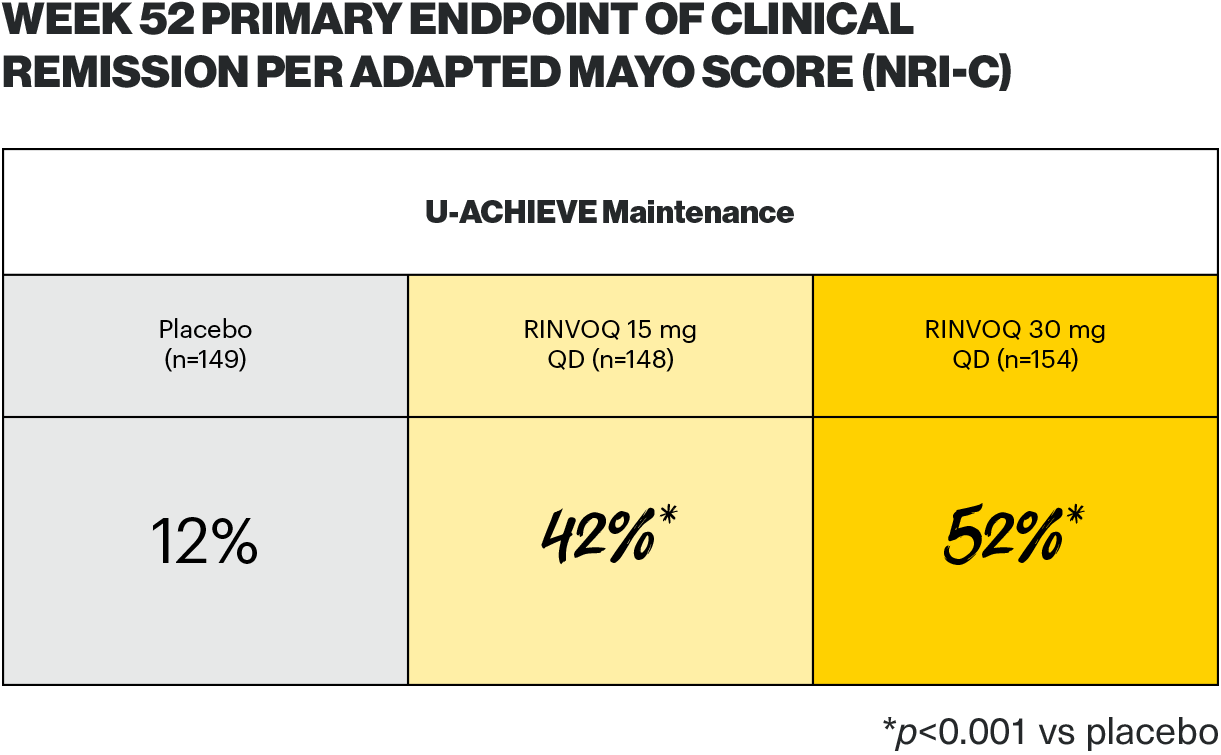
RINVOQ achieved the primary endpoints of clinical remission per adapted Mayo score at induction Week 8 and maintenance Week 52†
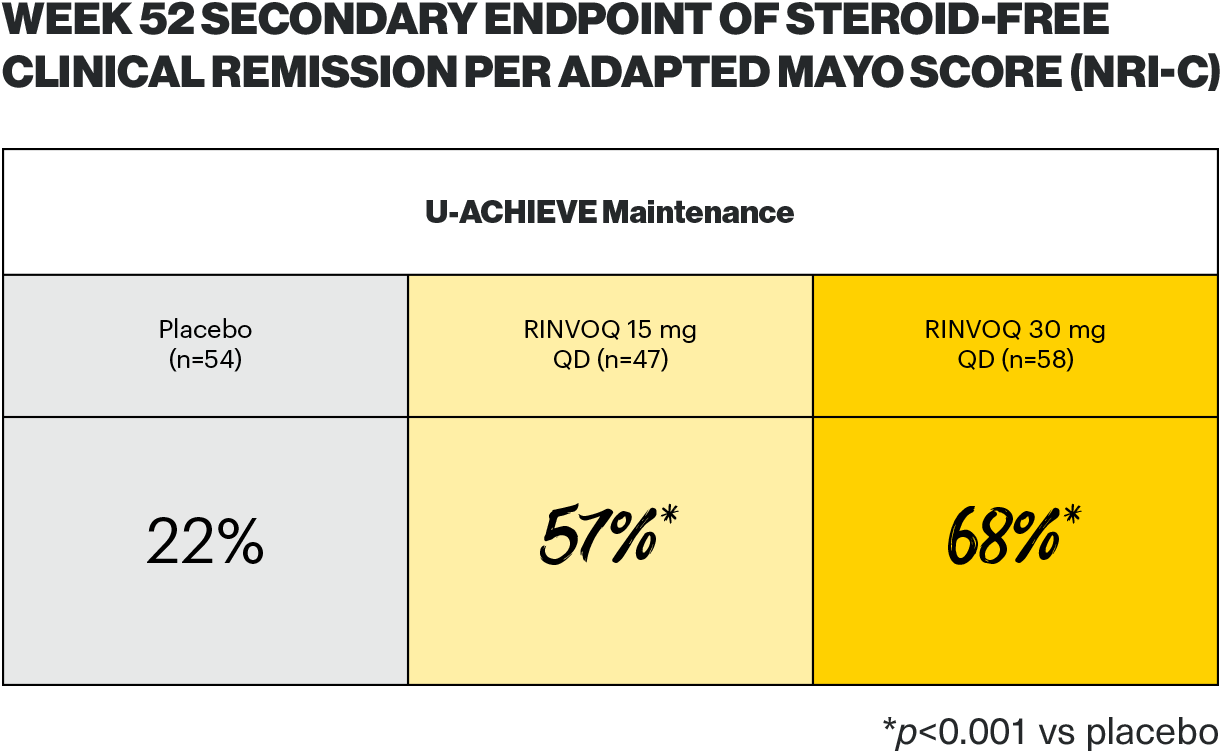
RINVOQ achieved steroid-free clinical remission per adapted Mayo score at Week 52 among those who achieved clinical remission at induction Week 8‡
Previous
Next
Clinical remission: defined as stool frequency subscore [SFS] ≤1 and not greater than baseline, RBS=0, endoscopic subscore [ESS] 0 or 1 without friability.
Steroid-free clinical remission: defined as clinical remission per aMs at Week 52 and corticosteroid-free for ≥90 days immediately preceding Week 52 among patients who achieved clinical remission at the end of the induction treatment.
MUCOSAL HEALING MEASURES AT INDUCTION WEEK 8 AND MAINTENANCE WEEK 52
MUCOSAL HEALING = ESS 0 or 1 without friability
HISTOLOGIC-ENDOSCOPIC MUCOSAL HEALING = ESS 0 or 1 without friability and Geboes ≤3.1
ESS: endoscopic subscore.
Geboes score: a measure of histologic inflammation, where a score of ≤3.1 indicates neutrophil infiltration in <5% of crypts, no crypt destruction, and no erosions, ulcerations, or granulation tissue.

RINVOQ's safety profile has been established in 18 Phase 3 trials across approved indications in rheumatology, dermatology and gastroenterology
*Clinical response, also known as symptomatic response, per partial adapted Mayo score defined as a decrease in partial adapted Mayo score ≥1 point and a ≥30% from baseline, PLUS a decrease in rectal bleeding score ≥1 or an absolute rectal bleeding score ≤1.1,2 †Clinical remission per adapted Mayo score at Week 8 induction and Week 52 were the primary endpoints. Clinical remission was measured per adapted Mayo score; Stool frequency subscore (SFS) ≤1 and not greater than baseline, rectal bleeding score (RBS) = 0, endoscopic subscore (ESS) 0 or 1 without friability.1,2 ‡Patients who achieved clinical remission per adapted Mayo score at induction Week 8 were eligible to be assessed for achievement of corticosteroid-free clinical remission at maintenance Week 52.1,2 §Mucosal healing (defined as an ESS of 0 or 1 without friability) at induction Week 8 and maintenance Week 52 were ranked secondary endpoints.1,2 Maintenance of mucosal healing at maintenance Week 52 was a ranked secondary endpoint and was assessed in patients who achieved mucosal healing with 8-week RINVOQ 45 mg induction treatment (n=216).2
Study design: U-ACHIEVE Induction (UC-1) and U-ACCOMPLISH (UC-2) were replicate induction studies, both of which were multicenter, double-blind, placebo-controlled clinical studies. In UC-1 and UCV-2, 988 patients (473 and 515 patients, respectively) were randomized to RINVOQ 45 mg QD or placebo for 8 weeks with a 2:1 treatment allocation ratio and included in the efficacy analysis. All enrolled patients had moderately to severely active UC defined as aMs of 5 to 9 with an ESS of 2 or 3 and demonstrated prior treatment failure including inadequate response, loss of response, or intolerance to prior conventional and/or biologic treatment.1,2 U-ACHIEVE Maintenance (UC-3) was a multicenter, doubleblind, placebo-controlled clinical study with 451 patient who achieved clinical response per aMs (decrease ≥2 points and ≥30% from Baseline and a decrease in RBS ≥1 from Baseline or an absolute RBS ≤1) with 8-week RINVOQ 45 mg QD induction treatment. Patients were rerandomized 1:1:1 to receive either RINVOQ 15 mg QD, 30 mg QD or placebo.1,2

Please consult the Summary of Product Characteristics for further details regarding contraindications, monitoring requirements and additional prescribing information prior to initiating RINVOQ


Ulcerative colitis

RINVOQ is indicated for the treatment of adult patients with moderately to severely active ulcerative colitis who have had an inadequate response, lost response or were intolerant to either conventional therapy or a biologic agent.

Atopic dermatitis

RINVOQ is indicated for the treatment of moderate-to-severe atopic dermatitis in adults and adolescents 12 years and older who are candidates for systemic therapy.

Rheumatoid arthritis

RINVOQ is indicated for the treatment of moderate-to-severe active rheumatoid arthritis in adult patients who have responded inadequately to, or who are intolerant to one or more disease-modifying anti-rheumatic drugs (DMARDs). RINVOQ may be used as monotherapy or in combination with methotrexate.

Psoriatic arthritis

RINVOQ is indicated for the treatment of active psoriatic arthritis in adult patients who have responded inadequately to, or who are intolerant to one or more DMARDs. RINVOQ may be used as monotherapy or in combination with methotrexate.

Ankylosing spondylitis

RINVOQ is indicated for the treatment of active ankylosing spondylitis in adult patients who have responded inadequately to conventional therapy.
AD: atopic dermatitis; AS: ankylosing spondylitis; ESS: endoscopic subscore; NRI-C: non-responder imputation incorporating multiple imputation to handle missing data due to COVID-19; PsA: psoriatic arthritis; QD: once-daily; RA: rheumatoid arthritis; RBS: rectal bleeding score; UC: ulcerative colitis.
REFERENCES
- RINVOQ Summary of Product Characteristics [DRAFT].
- Danese S, Vermeire S, Zhou W, et al. Lancet. Published online May 26, 2022. doi: https://doi.org/10.1016/S0140-6736(22)00581-5.
- McInnes IB, Anderson JK, Magrey M, et al. N Engl J Med. 2021; 384:1227–1239.
- Mease PJ, Lertratanakul A, Anderson JK, et al. Ann Rheum Dis. 2021;80:312–320.
- Van der Heijde D, Song IH, Pangan AL, et al. Lancet. 2019;394(10214):2108–2117.
- Rubbert-Roth A, Enejosa J, Pangan AL, et al. N Engl J Med. 2020;383(16): 1511–1521.
- Kameda H, Takeuchi T, Yamaoka K, et al. Rheumatology (Oxford). 2020;59(11):3303–3313.
- Xiaofeng Zeng, Dongbao Zhao, Sebastiao Radominski, Efficacy and Safety of Upadacitinib in Patients From China, Brazil, and South Korea With Rheumatoid Arthritis Who Have Had Inadequate Response to Conventional Synthetic Disease-Modifing Antirheumatic Drugs. Abstract presented at the European Congress of Rheumatology, 3–6 June 2020. Abstract SAT0160.
- ClinicalTrials.gov A Study to Evaluate Safety of Upadacitinib in Combination With Topical Corticosteroids in Adolescent and Adult Participants With Moderate to Severe Atopic Dermatitis (Rising Up). Available at: https://clinicaltrials.gov.ct2/show/NCT03661138. Accessed June 2022.
- Blauvelt A, Teixeira HD, Simpson El, et al. JAMA Dermatol. 2021;157(9):1047–1055.