
This promotional material is intended for UK Healthcare Professionals experienced in the diagnosis and treatment of rheumatological conditions. Specialist prescribing only: RINVOQ (upadacitinib) and HUMIRA (adalimumab) Prescribing Information and adverse event reporting information can be found below.
















Real-world evidence and Phase III data
SELECT-PsA 2 and UPJOINT
View this visual summary of UPJOINT, a real-world evidence poster presented at EULAR 2024, highlighting reduced symptom severity and an increased proportion of patients achieving minimal disease activity in patients treated with RINVOQ (upadacitinib) versus baseline. SELECT-PsA 2 provides corresponding Phase III randomised controlled trial data.
Click the thumbnail to explore
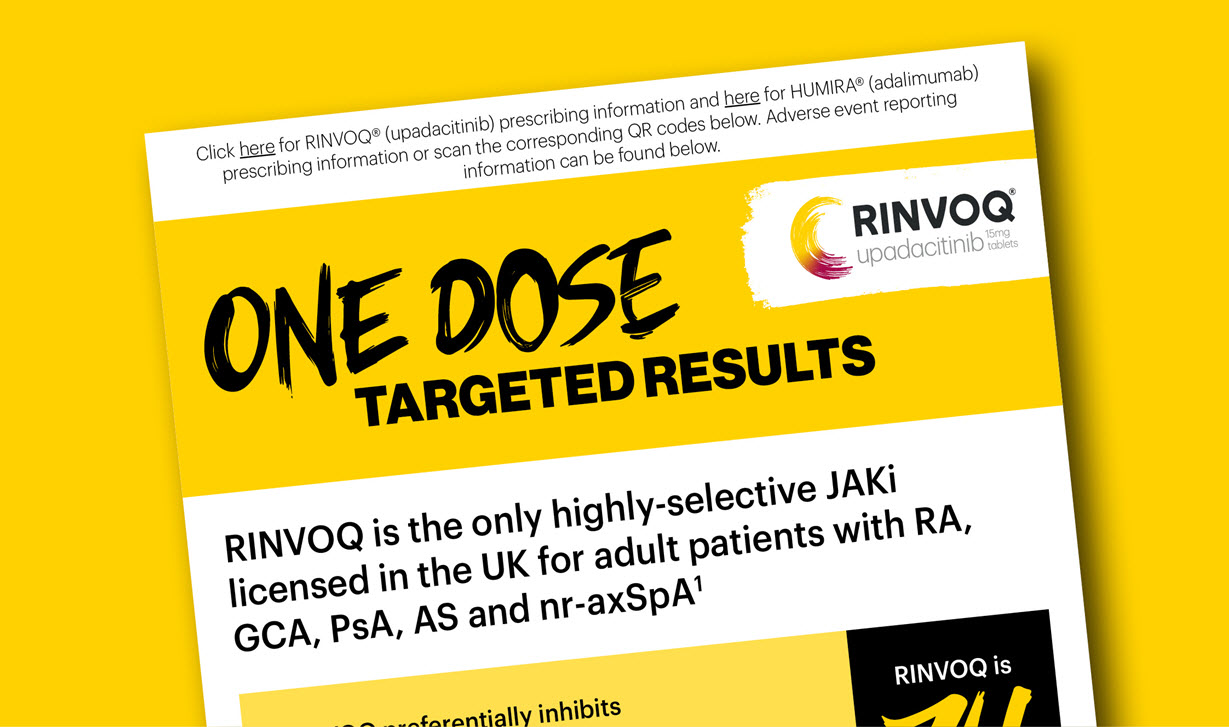
How does Rinvoq preferentially inhibit JAK1/3 receptors?
Learn more about the only highly selective JAK inhibitor, licensed in the UK for adult patients with RA, GCA, PsA, AS and nr-axSpA.
Click the thumbnail to explore
RINVOQ (upadacitinib) in Rheumatology Licensed Indications and Safety Information1
Full indications
Rheumatoid arthritis: RINVOQ is indicated for the treatment of moderate to severe active rheumatoid arthritis in adult patients who have responded inadequately to, or who are intolerant to one or more disease modifying anti-rheumatic drugs (DMARDs). RINVOQ may be used as monotherapy or in combination with methotrexate (MTX).
Psoriatic arthritis: RINVOQ is indicated for the treatment of active psoriatic arthritis in adult patients who have responded inadequately to, or who are intolerant to one or more DMARDs. RINVOQ may be used as monotherapy or in combination with MTX.
Axial spondyloarthritis
Ankylosing spondylitis (AS, radiographic axial spondyloarthritis): RINVOQ is indicated for the treatment of active ankylosing spondylitis in adult patients who have responded inadequately to conventional therapy.
Non-radiographic axial spondyloarthritis (nr-axSpA): RINVOQ is indicated for the treatment of active nr-axSpA in adult patients with objective signs of inflammation as indicated by elevated C-reactive protein (CRP) and/or magnetic resonance imaging (MRI), who have responded inadequately to nonsteroidal anti-inflammatory drugs (NSAIDs).
Some patients may not be suitable for RINVOQ. You are strongly advised to read the prescribing information (PI), which can be found here, and the risk minimisation materials which are available online in the Electronic Medicines Compendium (eMC) here.
RINVOQ is contraindicated in patients with: hypersensitivity to the active substance or excipients; active tuberculosis (TB) or active serious infections; severe hepatic impairment; pregnancy.
RINVOQ should only be initiated and supervised by healthcare professionals experienced in the diagnosis and treatment of rheumatological conditions.
Cautions (See Summary of Product Characteristics (SmPC) for full details including screening and monitoring requirements).
RINVOQ should only be used if no suitable treatment alternatives are available in patients:
- 65 years of age or older,
- with a history of atherosclerotic cardiovascular disease or other cardiovascular risk factors (such as current or past long-time smokers),
- with malignancy risk factors (e.g., current malignancy or history of malignancy)
RINVOQ is contraindicated in pregnancy. Women of childbearing potential have to use effective contraception during treatment and for 4 weeks following the final dose of RINVOQ. RINVOQ should not be used during breast feeding. A decision must be made whether to discontinue breast-feeding or to discontinue RINVOQ therapy taking into account the benefit of breast feeding for the child and the benefit of therapy for the woman.
Concomitant potent immunosuppressive medicines are not recommended. Increased risk of serious infection and viral reactivation (including herpes simplex and zoster reactivation) during treatment. Live attenuated vaccinations during or immediately prior to RINVOQ not recommended.
Cautions apply in patients ≥65 years, patients with malignancy risk factors; lymphoma and malignancies (including non-melanoma skin cancer) have been reported.
Haematological abnormalities: do not start, or temporarily interrupt existing therapy if: ANC <1x10⁹ cells/L, ALC <0.5x10⁹ cells/L or haemoglobin <8 g/dL. Haematological abnormalities have been reported. Caution in patients with risk factors for: gastrointestinal perforation (e.g. diverticular disease, NSAIDs, corticosteroids, opioids); cardiovascular disease/major adverse cardiac events; venous thromboembolism; severe renal and hepatic impairment (not recommended in end-stage renal impairment and to be used with caution in severe renal impairment, contraindicated in severe hepatic impairment). Hepatic transaminase elevations, increase in lipids and hypersensitivity reactions have been reported. Reports of hypoglycaemia following initiation of JAK inhibitors, including RINVOQ, in patients receiving medication for diabetes. Dose adjustment of anti-diabetic medication may be necessary. RINVOQ dose adjustment may be required with CYP3A4 inhibitors/inducers, avoid food/drink containing grapefruit. Retinal vein occlusion and medication residue in stool or ostomy output have been reported. Avoid use in acute relapses of giant cell arteritis. RINVOQ may have a minor influence on the ability to drive and use machines because dizziness and vertigo may occur.
Dosing in Rheumatological Conditions
Rheumatoid arthritis (RA), psoriatic arthritis (PsA) and axial spondyloarthritis (active non-radiographic axial spondyloarthritis (nr-axSpA) and ankylosing spondylitis (AS)
The recommended dose of upadacitinib is 15 mg once daily.
Consideration should be given to discontinuing treatment in patients with axial spondyloarthritis who have shown no clinical response after 16 weeks of treatment. Some patients with initial partial response may subsequently improve with continued treatment beyond 16 weeks.
Adverse reactions
For adverse reactions, please refer to the RINVOQ SmPC
Important safety information for HUMIRA® (adalimumab)2
Some patients may not be suitable for HUMIRA. You are strongly advised to read the prescribing information (PI), which can be found here, and the Risk Minimisation Materials which are available online in the Electronic Medicines Compendium (EMC) here. HUMIRA should only be initiated and supervised by healthcare professionals experienced in the diagnosis and treatment of conditions for which HUMIRA is indicated.
Rheumatoid arthritis
Humira in combination with methotrexate, is indicated for:
- the treatment of moderate to severe, active rheumatoid arthritis in adult patients when the response to disease-modifying anti-rheumatic drugs including methotrexate has been inadequate.
- the treatment of severe, active and progressive rheumatoid arthritis in adults not previously treated with methotrexate.
Humira can be given as monotherapy in case of intolerance to methotrexate or when continued treatment with methotrexate is inappropriate.
Humira has been shown to reduce the rate of progression of joint damage as measured by X-ray and to improve physical function, when given in combination with methotrexate.
Psoriatic arthritis
Humira is indicated for the treatment of active and progressive psoriatic arthritis in adults when the response to previous disease-modifying anti-rheumatic drug therapy has been inadequate. Humira has been shown to reduce the rate of progression of peripheral joint damage as measured by X-ray in patients with polyarticular symmetrical subtypes of the disease and to improve physical function.
Axial spondyloarthritis
Humira is indicated for the treatment of adults with severe active ankylosing spondylitis who have had an inadequate response to conventional therapy.
Humira is indicated for the treatment of adults with severe axial spondyloarthritis without radiographic evidence of AS but with objective signs of inflammation by elevated CRP and/or MRI, who have had an inadequate response to, or are intolerant to non-steroidal anti-inflammatory drugs (NSAIDs).
References:
1. RINVOQ SmPC 2025; 2. HUMIRA SmPC 2024.
UK-IMMR-260015 | March 2026