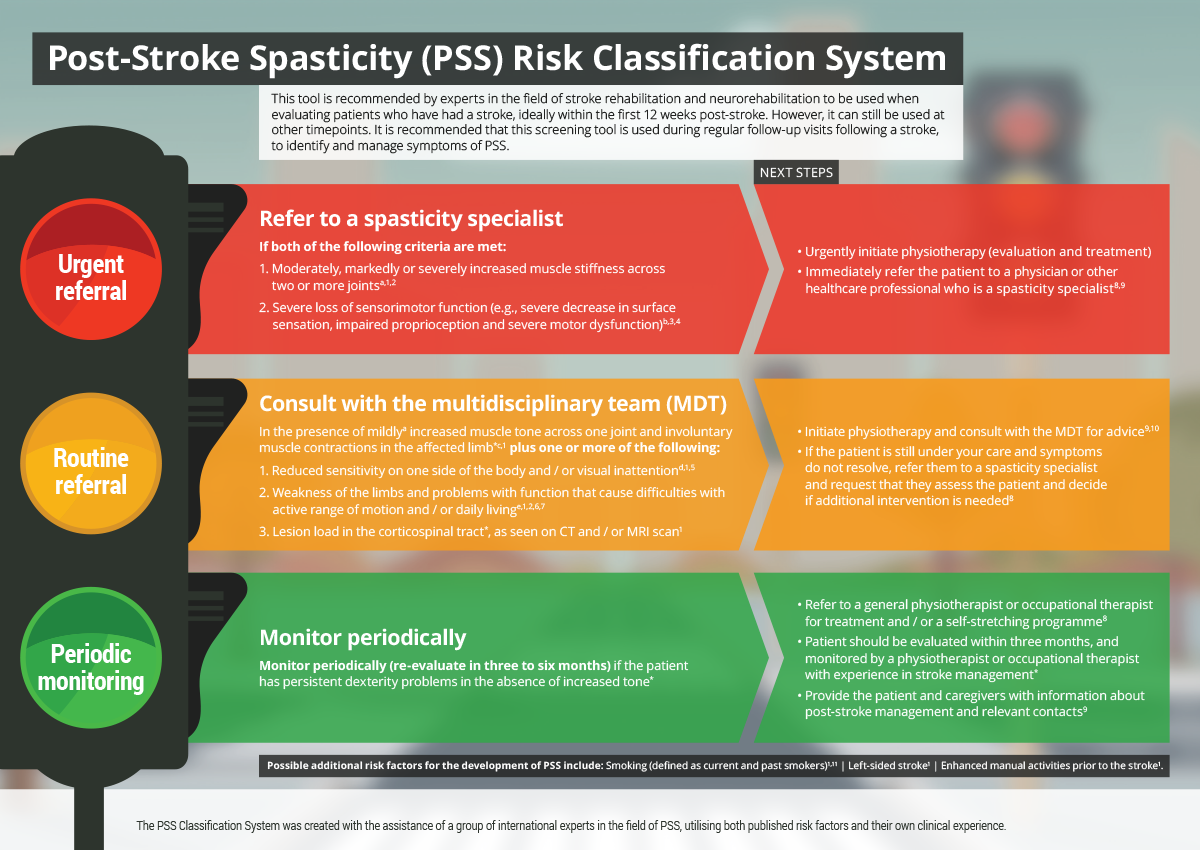
*Based on the clinical expertise of Dr Rhoda Allison, Dr Ganesh Bavikatte, Professor Philippe Marque, Associate Professor Barry Rawicki, Dr Maria Matilde de Mello Sposito, Dr Paul Winston & Professor Jörg Wissel.
- Mildly increased muscle stiffness is a Modified Ashworth Scale (MAS) 1 or +1, while moderately is MAS 2, markedly is MAS 3 and severe is MAS 4*. (See Bohannon RW et al. 1987 for more information)12.
- Measured using the Fugl-Meyer Upper Extremity Scale3 (see Fugl-Meyer ARet al. 1975 for more information)4.
- Muscle contractions may occur due to spasms, disturbed reciprocal inhibition or spastic dystonia and should be differentiated from contractures.
- Visual inattention includes hemianopsia, scotoma or visual neglect.
- Can be measured with the Barthel Index (low score) and EQ-5D (low score)18.
REFERENCES
- Wissel J, Verrier M, Simpson DM et al. Post-stroke spasticity: Predictors of early development and considerations for therapeutic intervention. PM R 2015; 7: 60-67.
- Sunnerhagen KS. Predictors of spasticity after stroke. Curr Phys Med Rehabil Rep 2016; 4: 182-185.
- Opheim A, Danielsson A, Murphy MA et al. Early prediction of long-term upper limb spasticity after stroke. Neurology 2015; 85: 873-880.
- Fugl-Meyer AR, Jääskö L, Leyman I et al. The post-stroke hemiplegic patient. Scand J Med 1975; 7: 13-31.
- Wilkinson D, Sakel M, Camp SJ et al. Patients with hemispatial neglect are more prone to limb spasticity, but this does not prolong their hospital stay. Arch Phys Med Rehabil 2012; 93: 1191-1195.
- de Jong LD, Hoonhorst MH, Stuive I et al. Arm motor control as predictor for hypertonia after stroke: A prospective cohort study. Arch Phys Med Rehabil 2011; 92: 1411-1417.
- N ijland RH, va Wegen EE, Harmeling-van der Wel BC et al. Presence of finger extension and shoulder abduction within 72 hours after stroke predicts functional recovery: early prediction of functional outcome after stroke: the EPOS cohort study. Stroke 2010; 41: 745-750.
- Bavikatte G, Subramanian G, Ashford S, Allison R, Hicklin D. Early Identification, Intervention and Management of Post-stroke Spasticity: Expert Consensus Recommendations. J Cent Nerv Syst. 2021;13.
- NICE Pathways: Stroke overview, available at: https://pathways.nice.org.uk/pathways/stroke#path=view%3A/pathways/stroke/movement-difficulties-after-a-stroke.xml&content=view-node%3Anodes-lowerlimb. [Last accessed: July, 2019].
- Duncan PW, Zorowitz R, Bates B et al. Management of adult stroke rehabilitation care: a clinical practice guideline. Stroke 2005; 36: e100-143.
- Leathley MJ, Gregson JM, Moore AP et al. Predicting spasticity after stroke in those surviving to 12 months. Clin Rehabil 2004; 18: 438-443.
- Bohannon RW and Smith MB. Interrater reliability of a Modified Ashworth Scale of muscle spasticity. Phys Ther 1987; 67: 206-207.
The PSS Classification System was created with the assistance of a group of international experts in the field of PSS, utilising both published risk factors and their own clinical experience.
AbbVie Pty Ltd. Mascot NSW 2020. ABN 48 156 384 262. PH 1800 252 224. © 2024 AbbVie. All rights reserved.
AU-NEUR-240033. November 2024.